
Kerala mural art is recognised for its expressive faces, strong outlines, richly layered colours, symbolic figures, and close connection with the visual traditions of temples and palaces. However, when the same style appears on canvas, many buyers naturally ask an important question: what makes authentic Kerala mural art on canvas genuinely original?
The answer is not simply the presence of a familiar deity, a bright colour palette, or an ornamental border. Authenticity is better understood through the relationship between the subject, drawing system, traditional technique, material choices, craftsmanship, and the honesty with which the artwork is presented.
Kerala mural painting developed as a highly disciplined art tradition. Its figures, gestures, colours, and decorative details follow established conventions rather than being created through casual imitation. Traditional murals were made for prepared architectural surfaces, while contemporary artists also adapt the visual language to canvas, wood, paper, and other portable materials. Kerala Tourism notes that the tradition has increasingly moved from permanent wall surfaces to canvas and paper, allowing more people to experience this heritage in homes and collections.
A good canvas mural should therefore do more than resemble the appearance of a temple painting. It should show care in its drawing, colour application, detailing, and interpretation of the tradition.
CHAPTERS
1. What Makes Kerala Mural Art Authentic?
2. The Historical Roots of Kerala Mural Painting
3. Traditional Techniques Behind Kerala Murals
a. Preparing the Surface
b. Drawing the Main Forms
c. Applying the Panchavarna Colours
d. Building Details, Expressions, and Ornamentation
4. Why the Five-Colour System Matters
5. Traditional Kerala Murals on Canvas
6. How to Recognise Quality and Authenticity
7. Choosing Kerala Mural Art for Your Home
8. Caring for a Handmade Kerala Mural Painting
Conclusion
1. What Makes Kerala Mural Art Authentic?
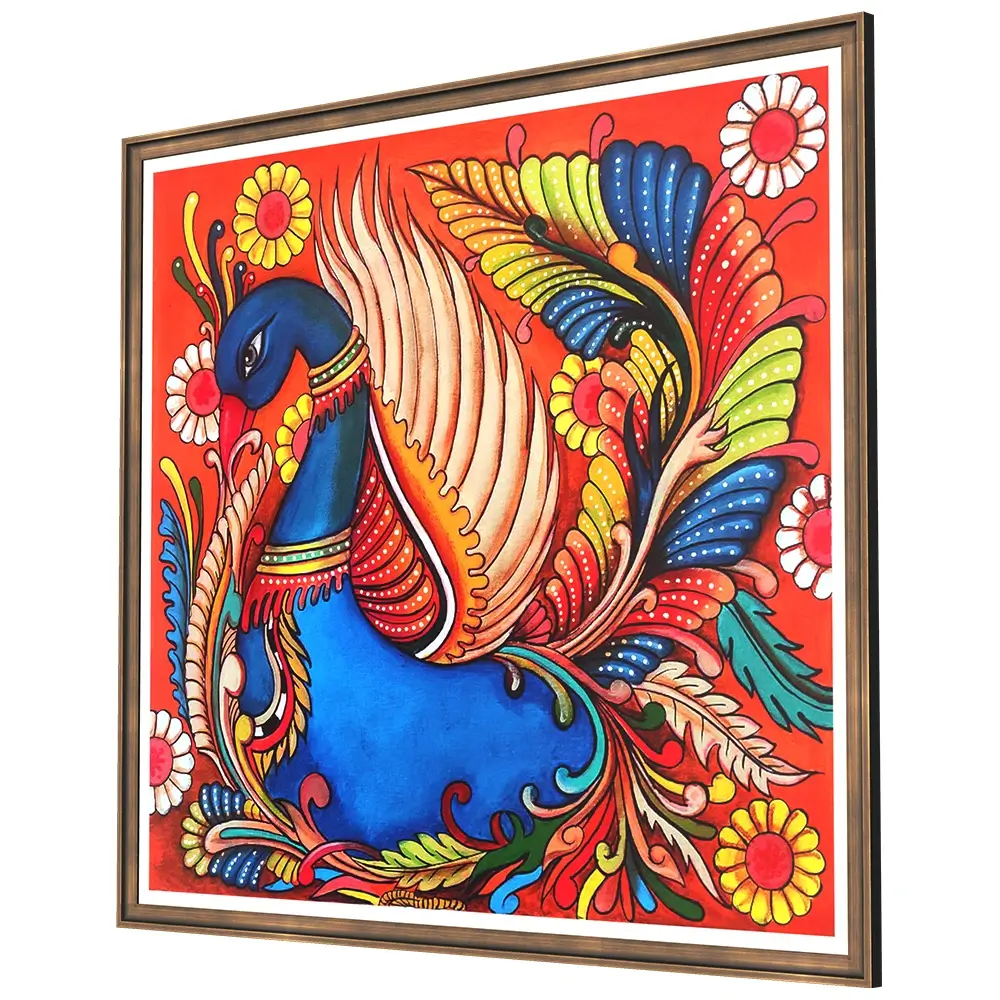
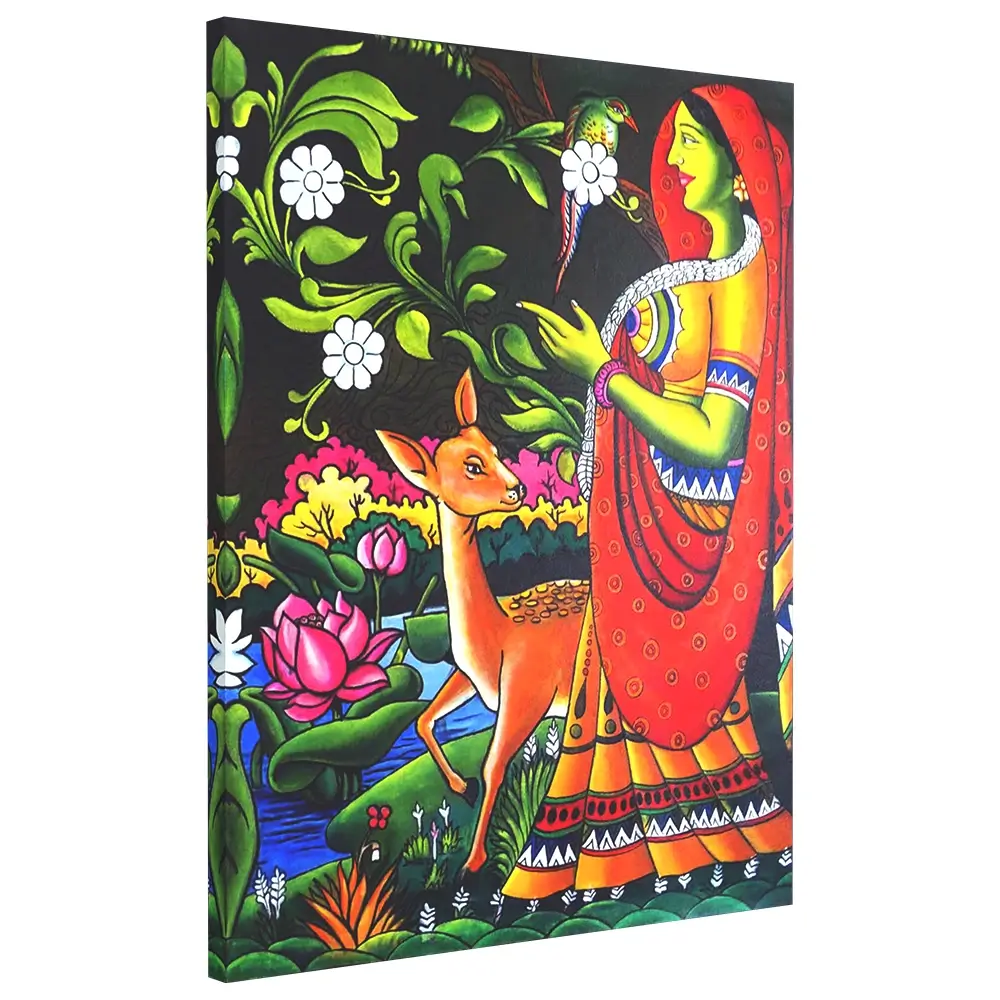
Authentic Kerala mural art begins with respect for the visual grammar of the tradition. This includes the way figures are drawn, the treatment of eyes and facial expressions, the use of ornamental details, the arrangement of colours, and the representation of mythological subjects.
The style is not based on ordinary realism. Instead, it uses a stylised approach in which the body, face, gesture, costume, and posture communicate identity and meaning. Traditional Kerala murals are closely associated with subjects from Hindu mythology, including stories connected with the Ramayana, Mahabharata, Bhagavata Purana, and other religious narratives.
A disciplined drawing system
One of the strongest signs of a carefully made mural is the quality of its drawing. The figure should feel balanced, intentional, and consistent from head to foot. Facial features should not appear randomly placed, and hands, ornaments, costumes, and gestures should support the character being represented.
In traditional practice, artists worked within established rules of proportion and iconography. These rules helped maintain consistency across religious figures and narrative scenes. As a result, the drawing stage is not a minor preliminary step. It is the foundation on which the entire painting depends.
A purposeful colour language
Kerala mural painting is strongly associated with the Panchavarna, or five-colour, system. The traditional palette is generally described through red, yellow, green, black, and white, with colours prepared from mineral, plant, and other natural sources. Historical documentation describes red and yellow pigments derived from earth materials, black from lamp soot, white from lime, and green from plant-based sources and mixtures.
These colours are not used only for decoration. They help establish mood, identity, emphasis, and symbolic meaning. The result is a visual language that feels powerful even when the artist works with a relatively restricted palette.
Careful line work and detailing
The outline is one of the most recognisable features of Kerala mural painting. Strong, controlled lines define the figure and separate important forms from the surrounding space. Decorative details are then developed through jewellery, clothing, floral patterns, facial features, and other carefully placed elements.
A hurried imitation may contain the correct subject but still feel weak because the lines are uncertain, the proportions are inconsistent, or the details appear mechanically repeated. In contrast, handmade craftsmanship becomes visible through the rhythm of the line, the balance of the composition, and the attention given to small features.
Honest presentation
Authenticity also depends on how the artwork is described. A contemporary painting inspired by Kerala mural traditions can be valuable and beautiful without being presented as an ancient temple original.
For example, a handmade canvas painting may use traditional Kerala mural imagery while adapting the surface, pigments, scale, or finishing method for modern interiors. That does not automatically make it inauthentic. The important point is that the artwork should be described accurately and transparently.
A responsible description should make clear whether the piece is:
- A traditional-style handmade painting.
- A contemporary interpretation of Kerala mural art.
- A reproduction or print.
- A painting based on a specific temple or mythological composition.
- An original artwork created by the artist.
This distinction helps buyers understand what they are purchasing and protects the cultural value of the tradition.
2. The Historical Roots of Kerala Mural Painting
Kerala mural painting developed within the sacred artistic environment of temples, palaces, and traditional buildings. These paintings were created not simply to decorate walls, but to communicate religious stories, spiritual ideas, and cultural traditions through colour, gesture, expression, and symbolism.
Many traditional Kerala murals depict Hindu deities, episodes from the Ramayana and Mahabharata, stories from the Puranas, and scenes associated with Krishna and other divine figures. The compositions usually combine expressive faces, carefully arranged figures, decorative borders, floral motifs, and symbolic objects. Every element contributes to the meaning and visual balance of the artwork.
The murals of Mattancherry Palace in Kochi are among the most recognised examples of Kerala’s mural heritage. They demonstrate how artists used large architectural surfaces to create narrative compositions filled with figures, ornaments, and decorative patterns. The paintings were designed to exist in harmony with the building, its pillars, ceilings, and surrounding architectural details.
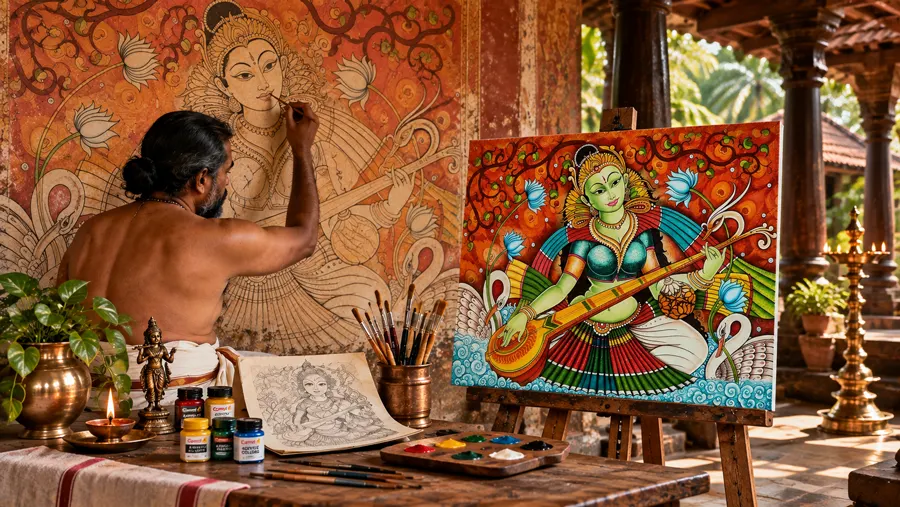
Historically, Kerala mural artists worked with carefully prepared surfaces and natural pigments. The process involved planning the composition, drawing the principal forms, applying colours, and developing the final details through controlled brushwork. The discipline of the artist was as important as the materials used.
Over time, Kerala mural painting moved beyond temple and palace walls into more portable formats, including wood, paper, board, and canvas. This allowed collectors and art lovers to bring the tradition into homes, offices, and personal art collections. Modern canvas paintings may use contemporary acrylic colours, but the strongest works still preserve the traditional principles of proportion, line, colour harmony, ornamentation, and expressive storytelling.
This transition from sacred wall painting to handmade canvas artwork does not mean that the tradition has been abandoned. Instead, it shows how Kerala mural art continues to evolve while retaining its distinctive visual identity.
Explore our full collection of original paintings, hand-painted on canvas by our artists in ASP Arts, Kerala, India.
3. Traditional Techniques Behind Kerala Murals
The beauty of Kerala mural art comes from the combination of preparation, drawing, colour, detailing, and patience. Each stage contributes to the final character of the painting.
(a) Preparing the Surface
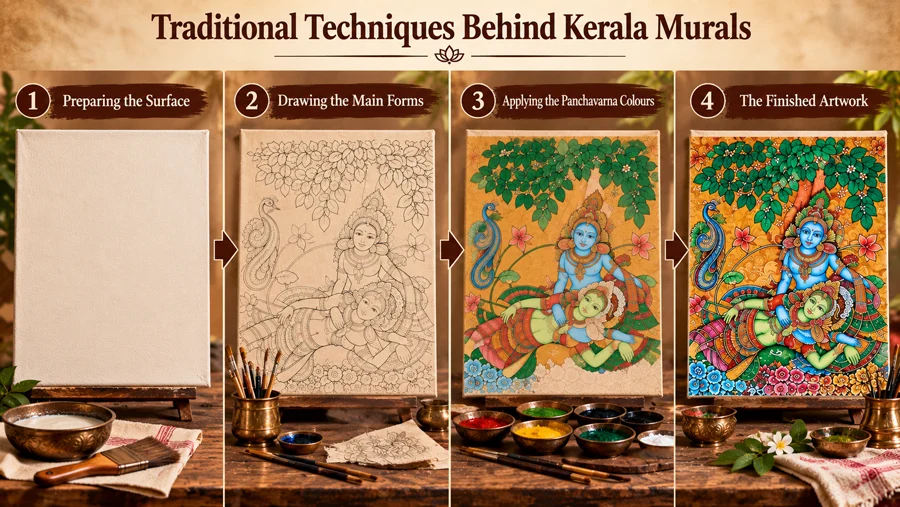
Traditional mural painting was associated with carefully prepared wall surfaces. The ground had to be sufficiently smooth and stable so that the artist could draw fine lines and apply colour without unwanted interruptions. Historical descriptions of Kerala mural practice refer to the preparation of the painting surface before the main drawing and colouring stages.
When the tradition is adapted to canvas, the surface must still be treated as an important part of the artwork. A good canvas should be properly stretched or mounted, primed, and prepared to receive the drawing and paint. An uneven or poorly prepared surface can affect the sharpness of outlines, the smoothness of colour areas, and the long-term appearance of the finished painting.
For a handmade canvas mural, the preparation stage may not be visible to the viewer, but it influences almost every detail that follows.
(b) Drawing the Main Forms
The initial drawing establishes the proportions, pose, facial expression, ornaments, clothing, and overall balance of the composition. In traditional Kerala mural art, the drawing is not a casual outline. It is the structural foundation of the painting.
Artists carefully plan the placement of the head, eyes, hands, arms, torso, and decorative elements. The face is especially important because the expression often carries the emotional and spiritual identity of the subject. A small change in the angle of an eye, the curve of a mouth, or the position of an eyebrow can alter the character of the entire figure.
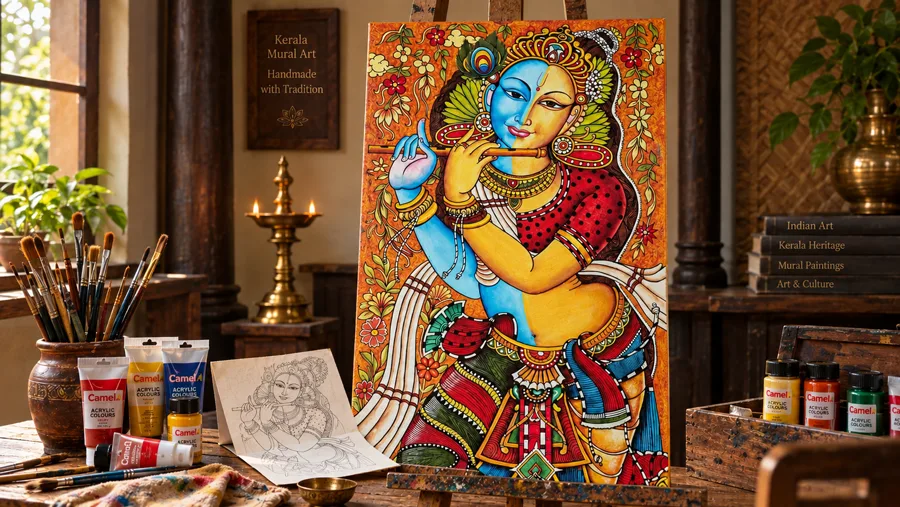
The rough folded sketch placed beside the completed artwork can help viewers understand this stage. It shows that the final image began with observation, planning, and hand-drawn decisions before the colours and intricate details were added.
(c) Applying the Panchavarna Colours
Kerala mural painting is traditionally associated with the Panchavarna or five-colour system. The commonly identified colours are red, yellow, green, black, and white. These colours form the basic visual vocabulary of the style, although artists may create variations, mixtures, and tonal differences while developing a painting.
The significance of Panchavarna lies not only in the colours themselves but also in their controlled application. Each colour contributes to the mood, symbolism, contrast, and balance of the composition.
- Red creates energy, intensity, and visual emphasis.
- Yellow adds warmth, radiance, and a sense of sacred brightness.
- Green supports natural forms, foliage, clothing, and ornamental patterns.
- Black strengthens outlines, separates forms, and gives definition.
- White creates highlights, contrast, and visual clarity.
In contemporary Kerala mural paintings, artists may use acrylic colours rather than traditional natural pigments. The material may be different, but the principle of deliberate colour placement remains important. Colours should support the subject instead of competing with it.
In the attached mural, the blue figure, green figure, warm golden background, red and pink clothing, white floral details, and dark outlines create a carefully balanced colour structure. The vivid appearance comes from the relationship between the colours, not simply from their individual brightness.
A skilled artist also understands when to leave a colour area relatively flat and when to add tonal variation. This helps preserve the decorative character of the mural while giving the figures a sense of volume.
(d) Building Details, Expressions, and Ornamentation
After the main forms and colour areas are established, the artist develops the fine details that give the painting its distinctive character. This stage may include facial expressions, jewellery, crowns, flowers, garments, peacock feathers, musical instruments, decorative borders, and symbolic accessories.
Kerala mural paintings are known for their intricate ornamentation and strong contour lines. Small repeated marks—such as dots, curved lines, bead-like patterns, leaves, petals, and textile designs—create rhythm across the surface. These details require patience and a steady hand.
The face is usually treated as one of the most important areas. The eyes and mouth must appear expressive without losing the stylised character of the tradition. The artist must also ensure that the ornaments and surrounding patterns support the main figure rather than overpower it.
The same care is required when painting clothing. Borders, pleats, folds, jewellery, and patterned fabrics are often developed through layers of lines and colour. These details help communicate the identity, mood, and cultural setting of the subject.
The final outlining stage is particularly important. Strong, controlled lines define the shapes and bring clarity to the composition. They separate overlapping forms and help the viewer understand the relationship between the figure, clothing, ornaments, flowers, animals, and background.
This is where a handmade Kerala mural becomes more than a coloured image. The individuality of the brushwork, the precision of the details, and the balance of the composition reveal the time and skill invested in the painting.
4. Why the Five-Colour System Matters
The five-colour system, commonly known as Panchavarna, is an important part of the visual identity of Kerala mural painting. The traditional palette is generally associated with red, yellow, green, black, and white. These colours are not used randomly; they are arranged with care to create harmony, contrast, symbolism, and visual clarity.
A limited palette gives the artist greater control over the composition. Instead of depending on numerous colours, the painter must understand how a small group of colours can express different moods, forms, and meanings. This discipline helps the artwork maintain a unified appearance, even when the composition includes several figures, elaborate ornaments, animals, flowers, and decorative patterns.
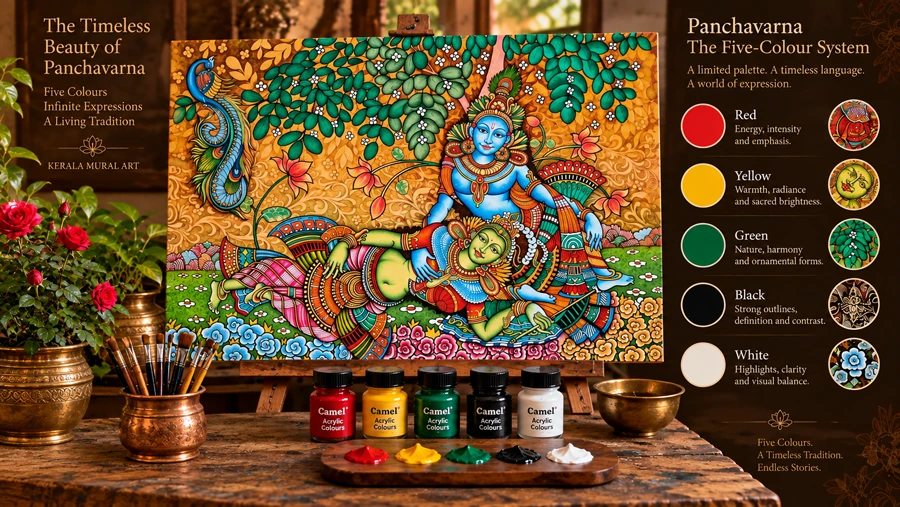
Each colour contributes a particular visual quality:
- Red introduces energy, intensity, and emphasis.
- Yellow creates warmth, radiance, and a sense of sacred brightness.
- Green connects the painting with nature, foliage, clothing, and ornamental forms.
- Black strengthens outlines and separates one form from another.
- White provides highlights, contrast, and visual breathing space.
The colours also help establish a clear hierarchy within the painting. The central figure must remain visually important, while the surrounding patterns and decorative elements should support the subject. Strong outlines, carefully placed highlights, and balanced colour areas allow the viewer to understand the composition without confusion.
In traditional mural painting, colour may also contribute to the symbolic identity of a figure. The skin colour, clothing, ornaments, and surrounding motifs can communicate the nature or role of a deity or character. Therefore, colour is not merely a surface treatment; it forms part of the visual language of the artwork.
Contemporary artists working on canvas may use acrylic colours instead of traditional natural pigments. This does not necessarily remove the mural character from the painting. What matters is whether the artist continues to respect the principles of controlled colour application, strong line work, balanced contrast, and traditional composition.
In the attached Krishna and Radha mural, the blue and green figures stand out against the warm golden background. Red, pink, orange, white, and dark outlines create additional contrast, while the foliage, peacock, lotus flowers, and patterned clothing connect the entire composition. The painting appears rich and colourful because the colours are carefully related to one another.
This is one of the reasons authentic Kerala mural art on canvas can feel both decorative and deeply structured. Its visual richness comes from discipline rather than excess. A skilled artist understands when to intensify a colour, when to soften it, and when to allow an outlined or lightly coloured area to create balance.
For collectors, the five-colour system is therefore an important quality indicator. A convincing Kerala mural should display colour harmony, controlled layering, and a clear relationship between the main figure and its surroundings. Brightness alone is not enough. The real strength lies in how thoughtfully the colours work together to preserve the traditional character of the painting.
5. Traditional Kerala Murals on Canvas
Traditional Kerala mural painting was originally created on architectural surfaces, especially the walls and ceilings of temples and palaces. Over time, artists began adapting the style to portable materials such as wood, board, paper, and canvas. This development allowed the art form to reach private homes, collectors, galleries, and contemporary interior spaces while preserving its traditional visual language.
A canvas mural is more than a printed reproduction of a traditional image. A genuinely handmade work involves drawing, colour application, detailing, and finishing carried out by the artist. The use of canvas changes the physical surface, but the artwork can still retain the characteristic features of Kerala mural painting: expressive faces, strong outlines, symbolic colours, elaborate ornaments, floral patterns, and carefully arranged figures.
Adapting the Tradition to a Modern Surface
Canvas provides several practical advantages. It is lighter than a mural painted directly onto a wall, easier to transport, and suitable for framing or displaying in different environments. It also allows collectors to own a traditional-style artwork without needing to alter the architecture of their home.
However, adapting a mural to canvas requires careful planning. The artist must consider the size and proportion of the canvas, the placement of the central figure, the balance of the background, and the relationship between the artwork and its future display space.
A composition that works well on a temple wall may need to be adjusted for a smaller canvas. Important details must remain visible, while the surrounding decorative elements should not make the painting feel crowded. The artist must preserve the visual richness of the tradition without losing clarity.
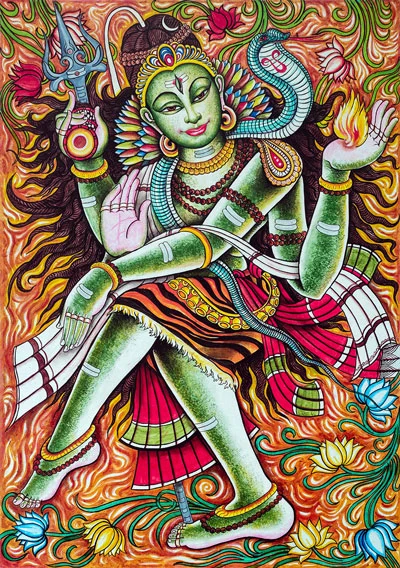
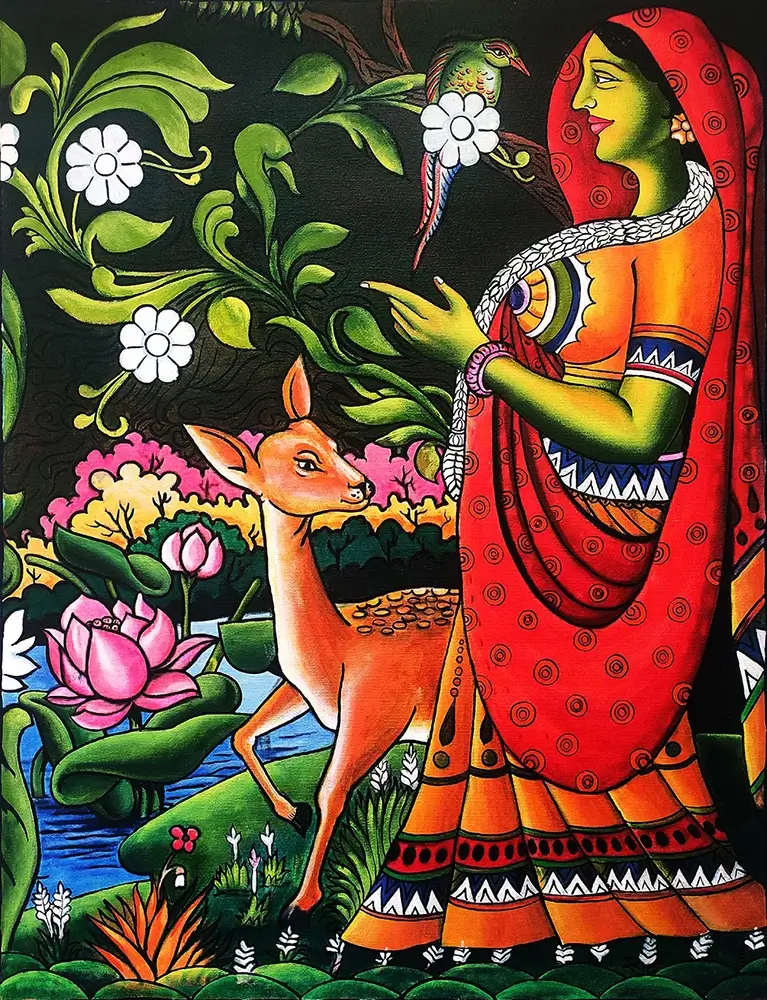
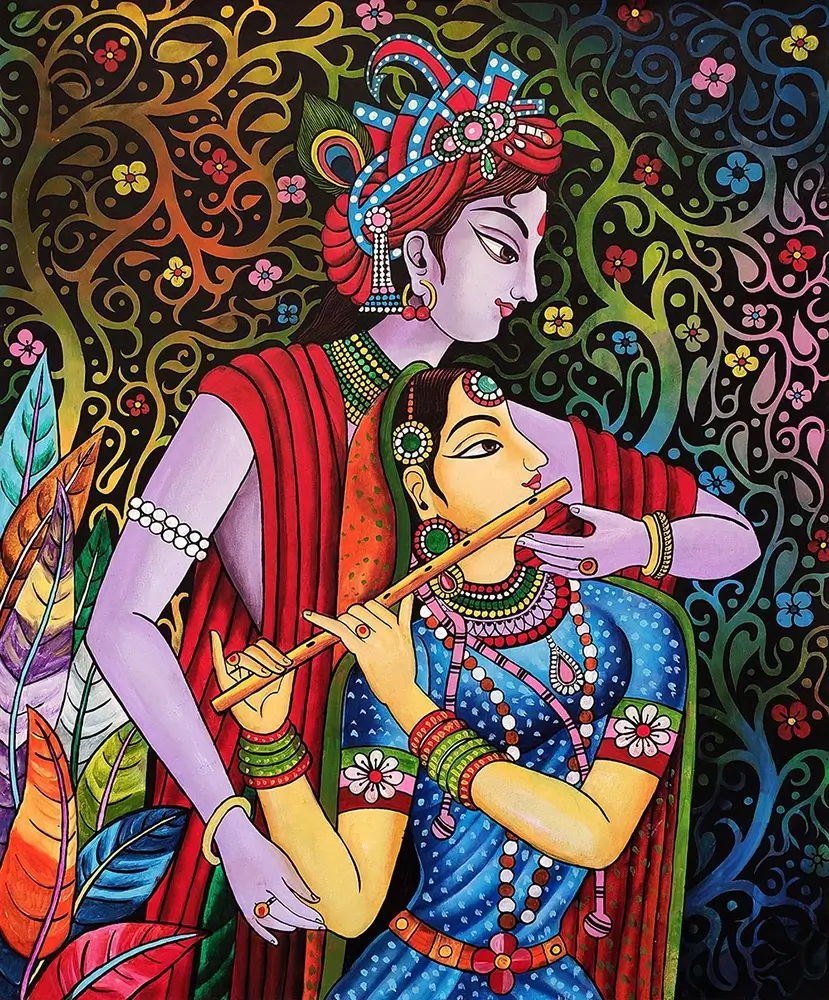
Handmade Painting Versus Printed Reproduction
Printed reproductions can provide an affordable way to enjoy the appearance of Kerala mural art. They are useful for décor and for people who want to introduce traditional imagery into their interiors at a lower cost.
A handmade mural on canvas offers a different experience. The artist’s brushwork, line variation, colour layering, and detailing become part of the artwork. Small differences in the pressure of the brush or the application of paint can give the surface an individual character.
This distinction is important when choosing authentic Kerala mural art on canvas. Buyers should check whether the artwork is hand-painted, digitally printed, or printed and then enhanced with paint. These are different forms of art production, and each should be described honestly.
A handmade painting should not be judged only by how closely it resembles a printed reference. Its value also comes from the time, skill, interpretation, and material process involved in creating it.
Preserving Traditional Visual Features
The use of modern acrylic colours does not automatically remove the traditional character of a Kerala mural. What matters is how the artist uses the medium.
A contemporary canvas mural can preserve important features such as:
- Strong and controlled contour lines
- Expressive, stylised facial features
- Carefully arranged body proportions
- Traditional ornamental patterns
- Symbolic use of colour
- Decorative floral and natural motifs
- Detailed jewellery, clothing, and accessories
- A balanced relationship between the central figure and the background
The artist may use modern brushes, prepared canvas, and acrylic colours while still following the principles of traditional mural composition. In this way, the medium becomes contemporary, but the artistic language remains connected to Kerala’s heritage.
Why Canvas Murals Suit Contemporary Interiors
Kerala mural paintings can work well in spaces that need colour, cultural character, and a strong visual focal point. A detailed mural may be displayed in a living room, entrance area, study, meditation space, office, boutique, or hospitality interior.
The artwork can be presented as a single statement piece or included within a larger traditional design scheme. Wooden furniture, brass décor, natural textures, neutral walls, and warm lighting can complement the painting without competing with its detailed composition.
Because Kerala murals often contain rich reds, greens, yellows, blues, and gold-like tones, the surrounding interior should be planned carefully. A quieter background can help the artwork remain the centre of attention. At the same time, small traditional accents such as a planter, carved wooden object, or brass ornament can create visual continuity.
The most successful display does not treat the mural as an isolated decorative object. It allows the painting’s cultural and artistic qualities to become part of the atmosphere of the room.
What Makes a Canvas Mural Meaningful?
A traditional Kerala mural on canvas becomes meaningful when it combines artistic skill with respect for the source tradition. The subject, composition, colours, and decorative details should work together rather than appear as disconnected decorative elements.
The painting should also communicate something about the artist’s process. A preliminary sketch, an unfinished section, visible brushwork, or a carefully documented creation stage can help viewers understand that the artwork was developed by hand.
For collectors, this process adds depth to the finished piece. The painting is not only an image of a deity or mythological scene; it is also the result of planning, drawing, colour selection, repeated detailing, and patient craftsmanship.
This is why handmade Kerala mural art on canvas continues to attract interest. It connects an older artistic tradition with the practical needs of modern art lovers, offering a work that can be displayed, collected, and appreciated while still carrying the distinctive character of Kerala mural painting.
6. How to Recognise Quality and Authenticity
Recognising quality in Kerala mural art requires more than checking whether a painting contains a deity, bright colours, or traditional decorative motifs. A well-made mural should demonstrate control over drawing, composition, colour, detailing, and finishing. Authenticity is connected to the artist’s process and understanding of the tradition, not merely to the appearance of the final image.
Examine the Drawing and Proportions
The first quality indicator is the underlying drawing. The main figure should have balanced proportions, a carefully arranged pose, and a clear relationship between the head, body, hands, ornaments, and surrounding elements.
The eyes and facial features deserve particular attention. Kerala mural painting uses a stylised form of expression, so the face should appear deliberate rather than loosely drawn. Uneven eyes, poorly aligned features, awkward hands, or inconsistent body proportions may indicate that the artist has copied the subject without fully understanding its structure.
A strong handmade mural usually shows confidence in the outline. The lines may have slight natural variations, but they should remain controlled and purposeful.
Look for Consistent Line Work
Line work is one of the defining features of Kerala mural painting. Outlines help separate the figures from the background and give clarity to jewellery, clothing, flowers, foliage, and other decorative details.
When examining a painting, look for:
- Clean and confident contours
- Consistent line thickness where appropriate
- Clear separation between overlapping forms
- Carefully finished borders and ornaments
- Fine details that remain connected to the larger composition
The lines should not appear excessively rough, accidental, or mechanically repeated. Handmade work can contain minor variations, but these should reflect the artist’s brush movement rather than a lack of control.
Observe the Colour Harmony
A quality mural should show a thoughtful relationship between its colours. Traditional Kerala mural painting is associated with a controlled colour vocabulary, including red, yellow, green, black, and white. The artist may use additional shades or modern acrylic colours, but the palette should still feel balanced and purposeful.
Check whether the main figure stands out clearly from the background. The colours of the clothing, ornaments, foliage, and decorative borders should support the subject instead of creating confusion.
Excessive brightness alone is not a sign of quality. A painting may use vivid colours and still feel unbalanced if the tones are applied without planning. In a well-developed mural, colour helps create depth, emphasis, rhythm, and visual unity.
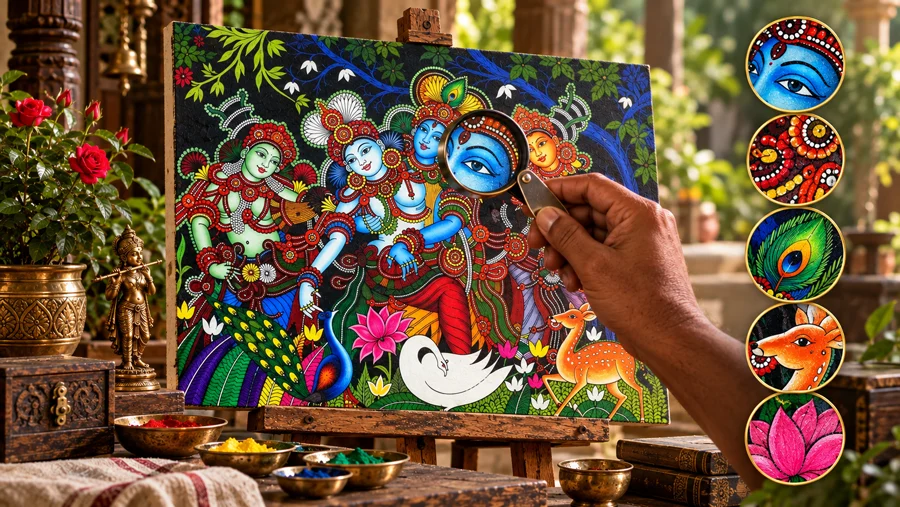
Inspect the Details and Finishing
Fine detailing often reveals the amount of time and attention invested in the artwork. Jewellery, crowns, textile patterns, floral motifs, feathers, facial markings, and decorative borders should be developed carefully.
Look closely at repeated patterns. Dots, beads, leaves, petals, and curved lines should appear intentional and reasonably consistent. Small unfinished areas, careless overlaps, visible gaps, or paint spreading outside the intended forms may affect the overall quality.
The finishing of the canvas is also important. The surface should be clean, the edges should be properly treated, and the artwork should not show unnecessary stains, cracks, or poorly covered areas. If the painting is framed, the frame should support the artwork without hiding or damaging its edges.
Ask About the Artist’s Process
A genuine handmade painting should have a clear creation process. The seller or artist should be able to explain how the composition was planned, how the drawing was developed, which colours were used, and how the final details were completed.
A preliminary sketch, progress photograph, or unfinished stage can help demonstrate this process. A small, folded sketch placed beside the artwork is one simple way to communicate that the artist worked from a reference and developed the composition by hand.
However, a sketch alone does not prove authenticity. It should be considered together with the quality of the finished painting, the artist’s explanation, and the consistency of the work.
Distinguish Handmade Work from Prints
Buyers should confirm whether the artwork is:
- Completely hand-painted
- Digitally printed
- Printed and manually enhanced
- A reproduction of an existing mural
- An original composition created by the artist
These categories have different artistic and commercial values. A printed reproduction can be attractive and affordable, but it should not be described as a fully handmade original.
For authentic Kerala mural art on canvas, the description should clearly state the production method. If acrylic colours were used, the seller should identify the medium accurately. If the painting is based on a traditional reference or an existing composition, that information should also be communicated honestly.
Consider the Cultural and Artistic Understanding
Authenticity is not limited to materials. It also involves respect for the visual principles of Kerala mural painting. The artist should understand the importance of expressive faces, symbolic colours, stylised anatomy, ornamental detailing, and balanced composition.
A painting may use modern canvas and acrylic colours while still reflecting this tradition. Conversely, a painting may use traditional-looking colours but lack the structure, discipline, and visual language associated with Kerala mural art.
The best way to judge a work is to consider the complete picture: the artist’s knowledge, the drawing quality, the colour arrangement, the detailing, the material process, and the honesty of the description.
A quality Kerala mural painting should feel carefully considered from beginning to end. It should show not only a beautiful subject, but also the patience, skill, and artistic understanding required to transform that subject into a convincing handmade work.
7. Choosing Kerala Mural Art for Your Home
Choosing Kerala mural art for your home is not only a décor decision. It is also an opportunity to introduce traditional craftsmanship, cultural meaning, and strong visual character into your living space. The right painting should suit the room while allowing the artwork itself to remain the focus.
Consider the Subject and Meaning
Begin by selecting a subject that has personal or cultural significance. Krishna, Radha, Ganesha, Shiva, Saraswati, and other traditional figures can bring different moods to an interior.
A Krishna mural may create a peaceful, devotional, or joyful atmosphere. A Ganesha painting may be suitable for an entrance, prayer area, or workspace. A composition featuring flowers, birds, peacocks, or natural elements may work well when the goal is to create a decorative connection with nature.
The subject should also match the purpose of the room. A highly detailed devotional painting may suit a meditation area, while a composition with softer colours and natural motifs may be more appropriate for a living room or reading space.
Choose the Correct Size
The size of the painting should relate to the wall, furniture, and viewing distance. A small mural may appear lost on a large empty wall, while an oversized artwork can make a compact room feel crowded.
Before purchasing, measure the available wall space and consider the furniture placed below or beside it. The painting should have enough surrounding space for its details to be appreciated.
Portrait-oriented Kerala murals can work well in narrow wall areas, beside doorways, or above tall furniture. Landscape-oriented compositions are often suitable for sofas, dining areas, consoles, and wider walls.
The artwork should be displayed at a comfortable eye level. If it is placed above furniture, leave enough space between the furniture and the lower edge of the frame so that the painting does not appear compressed.
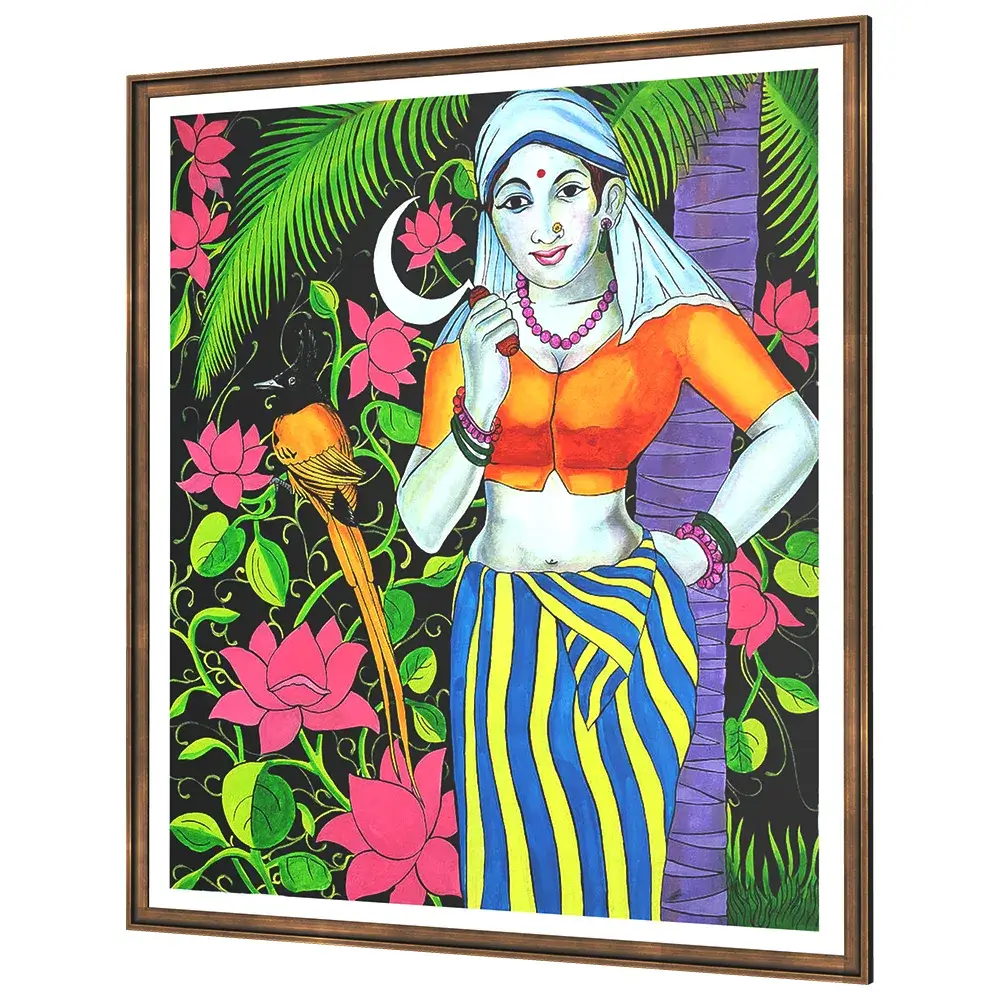
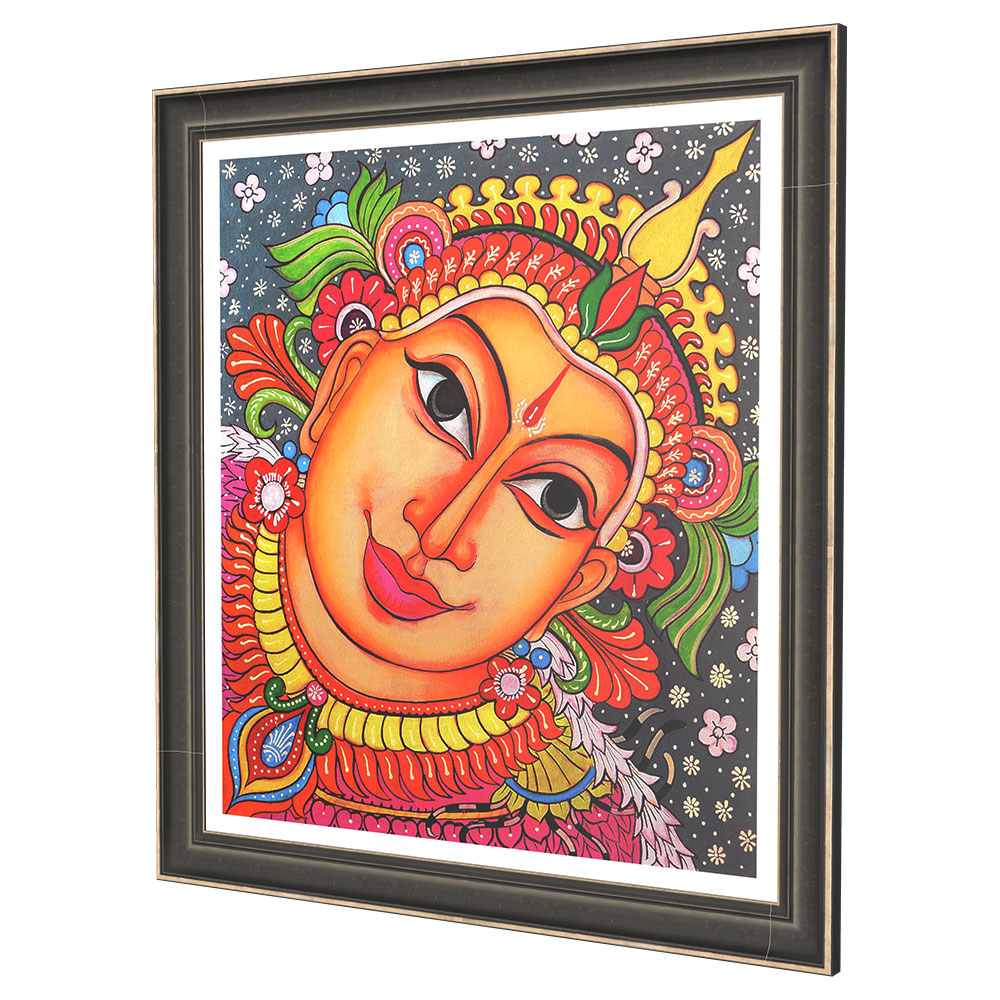
Match the Colour Palette with the Interior
Kerala mural paintings often contain rich colours, including red, yellow, green, blue, white, black, and warm earthy tones. These colours can become a strong focal point in a room.
If the interior has neutral walls and simple furniture, a colourful mural can add energy and depth. In a room that already contains many patterns or bright colours, a painting with a more balanced background may create better harmony.
Look for a relationship between the painting and the room’s existing elements:
- Wall colour
- Curtain and upholstery tones
- Wooden furniture
- Metal or brass décor
- Flooring materials
- Natural light
- Decorative accessories
The goal is not to match every colour exactly. Instead, select a painting that creates a pleasing connection between the artwork and the surrounding environment.
Think About Lighting
Lighting has a major influence on how a mural is experienced. Strong direct sunlight may affect certain paints and can create reflections on framed surfaces. Very dim lighting may hide the fine details that make Kerala mural art special.
Soft, indirect lighting is usually effective for detailed paintings. Adjustable wall lights or carefully positioned ceiling lights can highlight the face, ornaments, and central figures without producing harsh glare.
Before fixing the painting permanently, observe how the wall looks at different times of day. A mural that appears balanced in daylight may look different under warm evening lighting. The placement should allow the colours and detailing to remain visible without making the artwork appear overly bright.
Select a Suitable Frame
A frame should support the painting without competing with it. Wooden frames often complement the traditional character of Kerala mural art, especially in interiors that include natural materials or classical décor.
A simple frame may be better for a highly detailed painting, while a more ornamental frame can work when the room has a traditional or heritage-inspired style. The frame should also protect the edges of the canvas and allow the artwork to be displayed securely.
When choosing a frame, consider the colour and texture of the painting. Dark wood may strengthen a composition with strong black outlines, while a lighter wood frame may suit paintings with golden, green, or earthy backgrounds.
Decide Between a Statement Piece and a Collection
One large Kerala mural can serve as the main focal point of a room. This approach works especially well when the painting contains several figures, intricate ornaments, and a richly detailed background.
Alternatively, smaller paintings can be arranged as a collection. If choosing multiple works, maintain some connection between them through subject, colour, size, framing, or artistic style. Too many unrelated images may reduce the visual impact of each painting.
A collection can be developed gradually. Starting with one meaningful handmade mural allows the collector to understand the style, observe how it fits into the home, and choose future artworks with greater confidence.
Confirm the Artwork’s Production Method
Before purchasing, ask whether the painting is completely hand-painted, digitally printed, or printed and then enhanced with paint. This distinction is important because the production method affects the artwork’s character, price, and collectable value.
For authentic Kerala mural art on canvas, the description should clearly explain the medium and process. Buyers may also ask about the canvas quality, type of colours used, finishing method, framing options, and care instructions.
A transparent description helps clients make an informed decision and ensures that the artwork is purchased with realistic expectations.
Choose Art That You Will Continue to Enjoy
Trends may influence décor choices, but a traditional mural should ideally be selected for its lasting appeal. The subject, craftsmanship, and cultural connection should remain meaningful even if the room’s furniture or colour scheme changes later.
A carefully chosen Kerala mural can become more than a decorative feature. It may serve as a conversation piece, a cultural reminder, a spiritual image, or the beginning of a personal art collection.
The best choice is therefore a painting that combines visual suitability with personal meaning—an artwork that feels naturally connected to the home and continues to reward attention over time.
8. Caring for a Handmade Kerala Mural Painting
A handmade Kerala mural painting should be cared for carefully so that its colours, fine brushwork, and decorative details remain beautiful for many years. Proper maintenance is especially important because mural paintings often contain intricate outlines, layered colours, and delicate ornamental patterns.

Keep the Painting Away from Direct Sunlight
Continuous exposure to strong sunlight may affect the appearance of painted surfaces over time. Display the artwork in a location where it receives soft, indirect light rather than direct rays through a window.
If the painting is placed in a bright room, consider using curtains, blinds, or UV-protective glazing when framing it. Avoid positioning the artwork directly opposite a window where sunlight falls on the canvas for several hours each day.
Protect It from Moisture and Humidity
Moisture can affect both the canvas and the painted surface. Excess humidity may encourage mould growth, weaken the canvas, or cause changes in the way paint adheres to the surface.
Avoid placing the painting near:
- Bathrooms
- Kitchen sinks
- Open windows exposed to rain
- Damp walls
- Areas with frequent water vapour
- Air-conditioner outlets that produce condensation
The wall behind the artwork should be dry and free from seepage. If the room has a recurring dampness problem, resolve it before displaying the painting permanently.
Dust the Surface Gently
Dust should be removed carefully because rough cleaning can damage fine outlines and small decorative details. Use a clean, soft, dry brush or a gentle air blower to remove loose dust from the surface.
Do not scrub the painting with a cloth. Avoid using water, household cleaning sprays, detergents, or chemical solutions unless the artwork has been professionally assessed and the treatment has been recommended by a qualified conservator.
If the painting is framed behind glass or acrylic, clean the protective covering rather than touching the painted surface directly. Use a suitable soft cloth on the frame and glazing, taking care not to allow liquid to enter the frame.
Handle the Canvas Carefully
When moving a handmade mural, hold it by the frame or by both sides of the stretcher support. Do not press the painted surface with your fingers, and avoid placing objects directly against the canvas.
If the artwork is unframed and rolled for transport, it should be rolled carefully with the painted side facing outward only when recommended for that particular paint and surface. In many cases, professional packing is preferable, especially for large or highly detailed paintings.
Never fold a painted canvas. Folding can create permanent creases, cracks, or stress marks in the paint layer.
Choose the Right Display Position
The painting should be mounted securely on a stable wall. Avoid placing it where it may be struck by furniture, doors, children’s toys, or other objects.
Leave a small space between the painting and damp or uneven walls where possible. Proper hanging hardware is important for larger canvases because an unstable mounting system can cause the artwork to fall or become distorted.
If the painting is displayed in a busy area, consider framing it with protective glazing, provided the frame allows enough space between the glass and the painted surface.
Avoid Sudden Temperature Changes
Extreme or sudden changes in temperature may cause the canvas and paint layers to expand and contract at different rates. This can place stress on the artwork over time.
Keep the painting away from heaters, strong air-conditioning blasts, fireplaces, and areas where hot and cold air meet frequently. A stable indoor environment is generally better than a location with repeated temperature fluctuations.
Store the Painting Properly
If the mural needs to be stored temporarily, keep it in a clean, dry, and well-ventilated place. Do not store it directly on a damp floor or against an exterior wall.
Use protective wrapping that does not press against the painted surface. Avoid plastic wrapping that traps moisture for long periods. For long-term storage, acid-free materials and professional art-packing methods are preferable.
Do not place heavy objects on top of the painting or stack other artworks directly against its surface.
Seek Professional Help for Damage
If the painting develops cracks, peeling paint, stains, mould, or loose canvas, avoid attempting a home repair. Applying glue, varnish, oil, or household paint may cause further damage and make professional restoration more difficult.
A qualified art conservator can assess the condition and recommend an appropriate treatment. Early attention is usually better than allowing a small problem to spread.
Preserve the Artwork’s Story
A handmade Kerala mural painting becomes more meaningful when its history and creation details are preserved. Keep any available information about the artist, title, date of creation, materials, reference image, purchase, and framing.
This information can be useful for future care, insurance, resale, or collection records. It also helps maintain the cultural and artistic story connected with the artwork.
With careful handling, suitable lighting, protection from moisture, and gentle cleaning, a handmade Kerala mural painting can remain a lasting part of a home and continue to be appreciated for its craftsmanship, colour, and traditional character.
Conclusion
Authentic Kerala mural art on canvas brings together tradition, craftsmanship, symbolism, and contemporary presentation. Its beauty is not created by colour alone, but through the careful relationship between drawing, proportion, expressive faces, decorative details, and a disciplined colour system.
From the sacred walls of Kerala’s temples and palaces to modern homes and art collections, the mural tradition continues to evolve while retaining its distinctive character. Handmade canvas paintings make this heritage more accessible, allowing collectors to appreciate traditional imagery in a practical and lasting format.
When choosing a Kerala mural, look beyond the subject and visual brightness. Consider the quality of the drawing, the confidence of the line work, the harmony of the colours, the precision of the ornamentation, and the honesty of the artist’s production process. A truly meaningful painting reflects both artistic skill and respect for the tradition.
Proper care is equally important. Protecting the artwork from direct sunlight, moisture, dust, sudden temperature changes, and careless handling helps preserve its colours and fine details for years to come.
A handmade Kerala mural painting is more than a decorative object. It is a connection to cultural history, artistic discipline, and the continuing story of Kerala’s visual heritage. Whether selected as a single statement piece or as the beginning of a personal collection, it can bring lasting beauty, character, and meaning into the home.