
The bedroom is the one room in the house where the wrong painting can actually cost you sleep. It sounds dramatic, but think about it — you’re not glancing at this piece for a few seconds on your way through. You’re looking at it right before you close your eyes and right after you open them. That’s a different job than any other wall in the house.
Here’s how to choose bedroom wall art that actually supports rest, instead of just filling the space above the headboard.
Why the Bedroom Is Different from Every Other Room
Most rooms are decorated for how they look when you’re active, entertaining, working, cooking. A bedroom is decorated for how it feels when you’re winding down and trying to switch off. That single difference changes almost every decision, including which paintings belong on the wall and which ones, however striking, are better suited elsewhere in the house.
What to Avoid Above the Bed
Skip anything with high drama or intensity — fierce animals, stormy scenes, harsh contrast. These work beautifully in a living room where energy is welcome, but they’re the wrong note for a room meant to wind down in. Also be cautious with very busy, detail-heavy compositions; they give your eyes something to keep working on when they should be relaxing.
It’s also worth avoiding paintings with unresolved or unsettling narratives, anything that raises a question the eye wants to keep chewing on. A bedroom painting should feel complete and settled the moment you look at it, not like a puzzle demanding your attention.
What Works Well Instead
Soft color palettes, gentle subjects, and a sense of calm movement rather than tension. Think dusk or dawn light rather than midday glare, quiet water rather than crashing waves, a single resting animal rather than one mid-motion.
It’s also worth considering how the painting will look in the near-darkness of early morning or late evening, since a bedroom is often viewed in low light more than bright daylight. A piece with too much fine detail can lose all of its nuance in dim light, appearing as a flat, indistinct shape, while a simpler composition with clear tonal contrast tends to remain legible and calming even when the room’s lighting is soft and low.
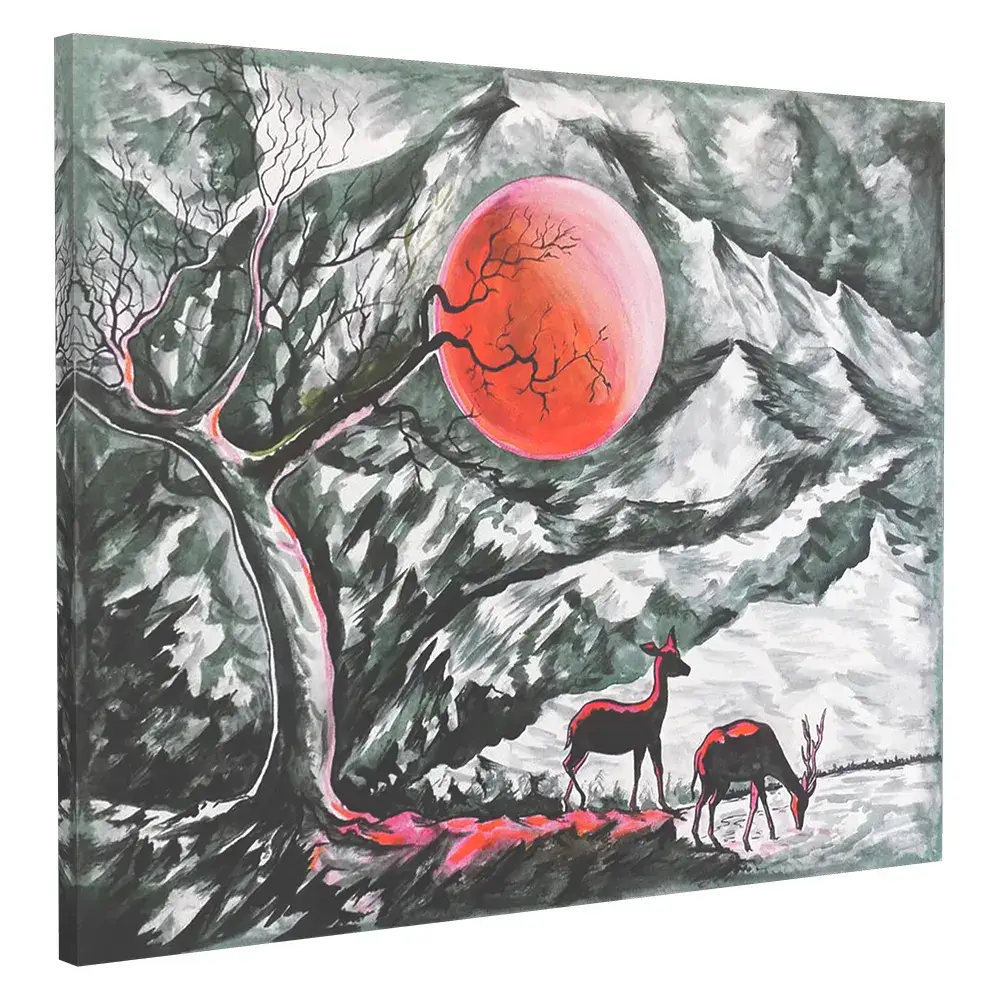
Moonlit and dusk scenes work especially well here — they echo the low light of the room itself rather than contrasting with it.
Color Choices for Better Rest
Cooler, muted tones, soft blues, sage greens, warm greys, tend to support the sense of calm a bedroom is going for, while bright, saturated colors can feel stimulating in exactly the room where you want the opposite. This doesn’t mean every bedroom painting needs to be pale or washed out; a deep, rich navy or a warm charcoal can still feel restful if the composition itself is quiet, since it’s the mood and detail level that matter more than the depth of the color.
Sizing for Above the Headboard
As a rule of thumb, the painting should span roughly two-thirds to three-quarters of the headboard’s width. Too narrow and it looks like an afterthought floating above the bed; too wide and it overwhelms the furniture below it. Leave 15-20cm of space between the top of the headboard and the bottom of the frame.
One Piece or a Pair
A single large painting centered above the bed reads as calm and deliberate — usually the better choice for a room built around rest. A pair of smaller, matching pieces flanking the headboard can work too, but it introduces more visual activity, so save that approach for a bedroom that can handle a bit more energy.
Beyond the Headboard: Other Bedroom Walls
The headboard wall gets most of the attention, but other walls in a bedroom deserve consideration too. A reading chair in the corner benefits from its own smaller piece, positioned at seated eye level, since that’s the spot where you’ll actually spend focused time looking at it. The wall opposite the bed, the one you see first thing in the morning, is worth choosing deliberately as well; a gentle, uplifting scene here can set a more positive tone for the day than a bare wall or a mirror alone.
Bedroom Art for Couples vs Solo Bedrooms
A shared bedroom benefits from art both partners genuinely like, which sometimes means choosing something more neutral in subject, a landscape or an abstract piece, rather than something with a strong personal association for only one person. A solo bedroom has more room for individual taste, and can lean further into a specific mood or subject that reflects one person’s preferences without needing to accommodate anyone else’s.
Guest Bedrooms Deserve the Same Thought
It’s tempting to treat a guest bedroom as an afterthought, hanging whatever leftover art didn’t find a place elsewhere in the house. But guests notice, and a calm, well-chosen painting in a spare room signals genuine hospitality in a way that’s easy to overlook. Since you won’t know every guest’s personal taste, a neutral, universally calming choice, a soft landscape or a gentle monochrome piece, tends to work better in a guest room than something with strong personal meaning to you specifically.
Lighting for Bedroom Art
Avoid bright, direct overhead lighting on bedroom art, since it works against the calm mood you’re trying to build. A soft bedside lamp, a warm-toned wall sconce, or gentle ambient lighting lets the painting be visible without feeling like a spotlight. Some people prefer their bedroom art to be barely visible at night and only properly seen during the day, which is a perfectly reasonable choice for a room that’s used differently depending on the hour.
Caring for Bedroom Art
Dust gently and regularly with a soft, dry cloth. Keep the piece out of direct sunlight if the bedroom gets strong morning or afternoon light through the windows, since fading happens faster than people expect in a room with a consistent daily light pattern. Avoid hanging art directly above a humidifier or near an en-suite bathroom door where steam can reach the canvas.
Common Mistakes to Avoid
The most frequent mistake is choosing bedroom art the same way you’d choose art for a living room, prioritizing visual impact over the mood the room actually needs. A painting that looks striking in a showroom or online listing can feel overstimulating once it’s the last thing you see every night. The second mistake is hanging the piece too high, pushed toward the ceiling rather than centered relative to the headboard, which throws off the proportions of the whole wall. The third is neglecting the walls beyond the headboard entirely, leaving the rest of the room feeling unfinished even when the main piece is well chosen.
Framing Choices for a Restful Room
Simple, understated frames suit bedroom art best, natural wood, thin black or white, or no frame at all on a gallery-wrapped canvas. Heavy, ornate, or highly reflective frames can catch light in ways that feel jarring in low evening lighting, working against the calm the room is meant to have. If you’re hanging art near a window, consider how frame glare might interact with morning light before finalizing the placement.
A Quick Buying Checklist
- Choose muted, cooler tones for the headboard wall specifically; bolder pieces can go elsewhere in the room
- Avoid intense, high-drama, or unresolved-feeling compositions above the bed
- Size the painting to roughly two-thirds to three-quarters of the headboard’s width
- Consider the wall opposite the bed, the first thing you see each morning, as a separate design decision
- Choose simple, low-glare framing to suit the room’s evening lighting
Frequently Asked Questions
Can I hang a bold, colorful painting in a bedroom?
You can, particularly on a wall away from the bed itself, like the entry wall or a reading nook. Reserve the calmer, muted pieces specifically for the headboard wall, which is the one you look at while trying to fall asleep.
Is it bad Feng Shui or Vastu to have certain paintings in a bedroom?
Different traditions have different views on this, and it’s worth researching the specific guidance you follow if that matters to you. From a purely practical decor standpoint, calm, low-energy imagery tends to support better rest regardless of any belief system.
Should children’s bedrooms follow the same rules?
Largely yes, though children’s rooms can handle a bit more playfulness and color than an adult bedroom, since the goal is a happy, comforting space rather than strictly minimal calm.
What’s the ideal height to hang art above a bed?
Leave roughly 15-20cm between the top of the headboard and the bottom of the frame, with the painting centered on the width of the bed or headboard rather than the wall itself.
Does the season affect what art suits a bedroom?
Not significantly, since a bedroom’s mood needs are fairly consistent year-round: calm, low-stimulation, restful. Unlike a living room where seasonal decor changes are common, most people prefer to keep bedroom art fixed rather than rotating it.
What if my partner and I disagree on bedroom art?
A neutral subject, a landscape or a quiet abstract piece rather than something tied to one person’s specific taste or interest, is usually the easiest compromise, since it avoids the room feeling like it belongs to only one of you.
The Bottom Line
Bedroom wall art has one job above all others: to support rest, not compete with it. Choose something soft in tone, simple in subject, and sized to the bed rather than the wall, and the room will feel calmer the moment it’s up.
Browse our monochrome and landscape collections for pieces suited to a bedroom, all hand-painted on canvas by our artists in India.