
There’s a reason a hotel lobby with a living wall feels better than one with none. It’s not just decoration. Humans are wired to respond to nature, even a painted version of it. That instinct has a name in design circles — biophilic design. It’s become one of the defining ideas in home decor for 2026.
Not everyone has room for an indoor garden or a wall of plants. But almost everyone has a wall that could hold a painting, and that’s where biophilic design gets genuinely accessible.
What Biophilic Design Actually Means
Strip away the jargon and it’s a simple idea. Rooms that reference the natural world — through light, texture, plants, or imagery — tend to lower stress and improve focus compared to rooms that don’t. Offices have been using this for years with living walls and big windows. Homes are catching up, and wall art is one of the easiest ways to do it.
A landscape painting isn’t just filling wall space at that point. It’s doing the same psychological job as a window with a good view. There’s no need for an actual forest outside.
Where the Idea Comes From
Biologist E.O. Wilson popularized the term decades ago to describe humanity’s innate pull toward nature and other living things. Designers picked up the idea and applied it to buildings. Hospitals with garden views showed faster patient recovery, offices with natural light and greenery reported higher productivity, and homes with visible connections to nature scored higher on resident wellbeing surveys. Wall art became part of that toolkit because it offers a version of “nature exposure.” It works in any room, at any budget, regardless of the view outside your actual window.
Choosing Nature-Inspired Art That Works
Not every landscape reads as calming. A stormy seascape has a very different effect than a quiet forest path. If the goal is the classic biophilic benefit — lower stress, more focus — lean toward scenes with these qualities:
- Soft, natural light rather than harsh contrast
- Greenery, water, or open sky rather than dense, closed-in scenes
- A sense of depth — a path, a horizon, something the eye can travel into
- Earthy, muted color palettes over anything jarring
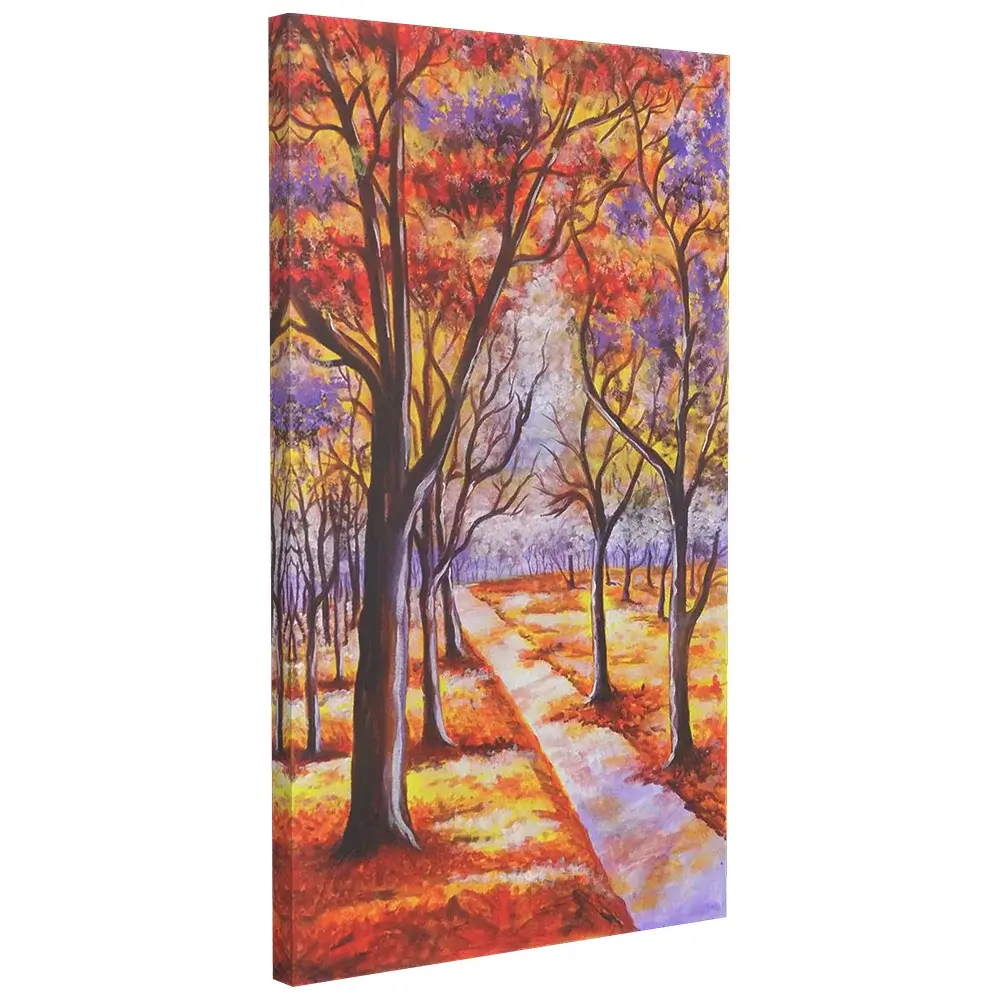
A path leading into the trees does something specific: it gives the eye somewhere to go. That’s part of why forest scenes read as calming rather than static.
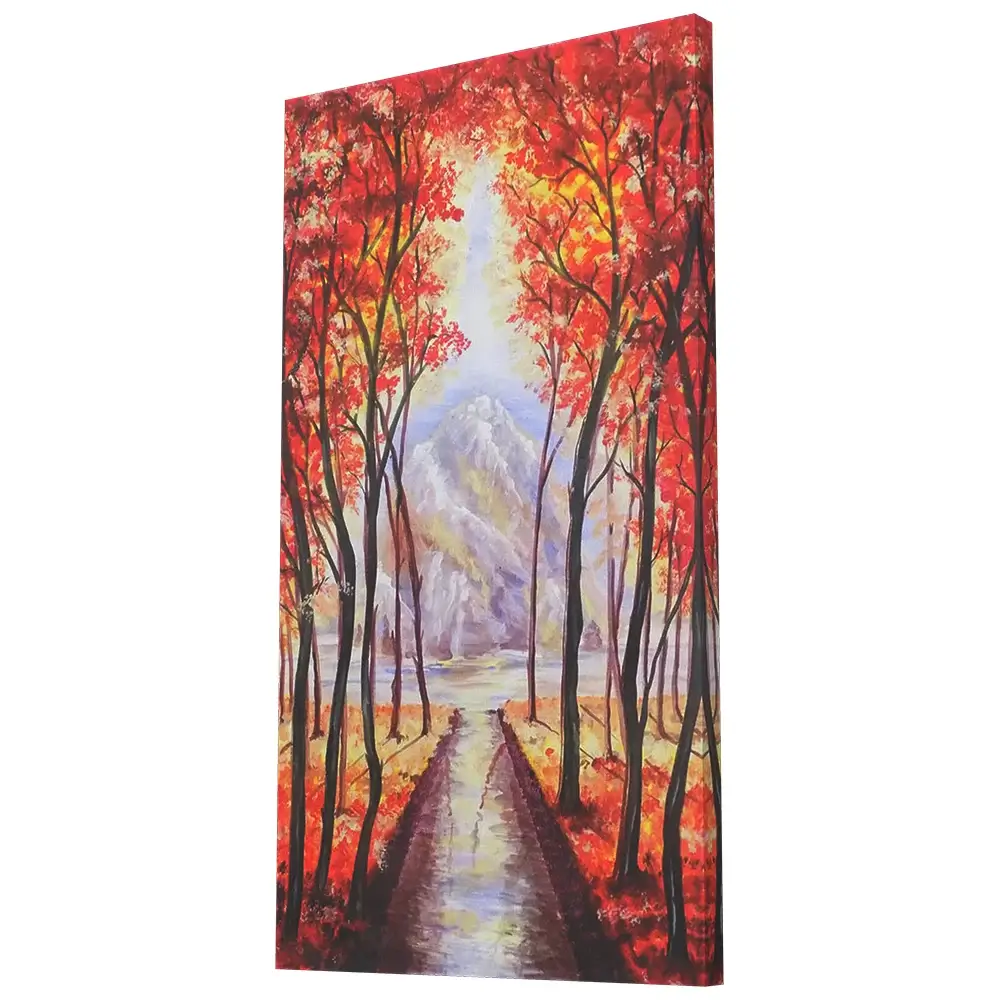
Water shows up again and again in biophilic research as one of the most calming elements you can put in a room. Even a painted lake does some of that work.

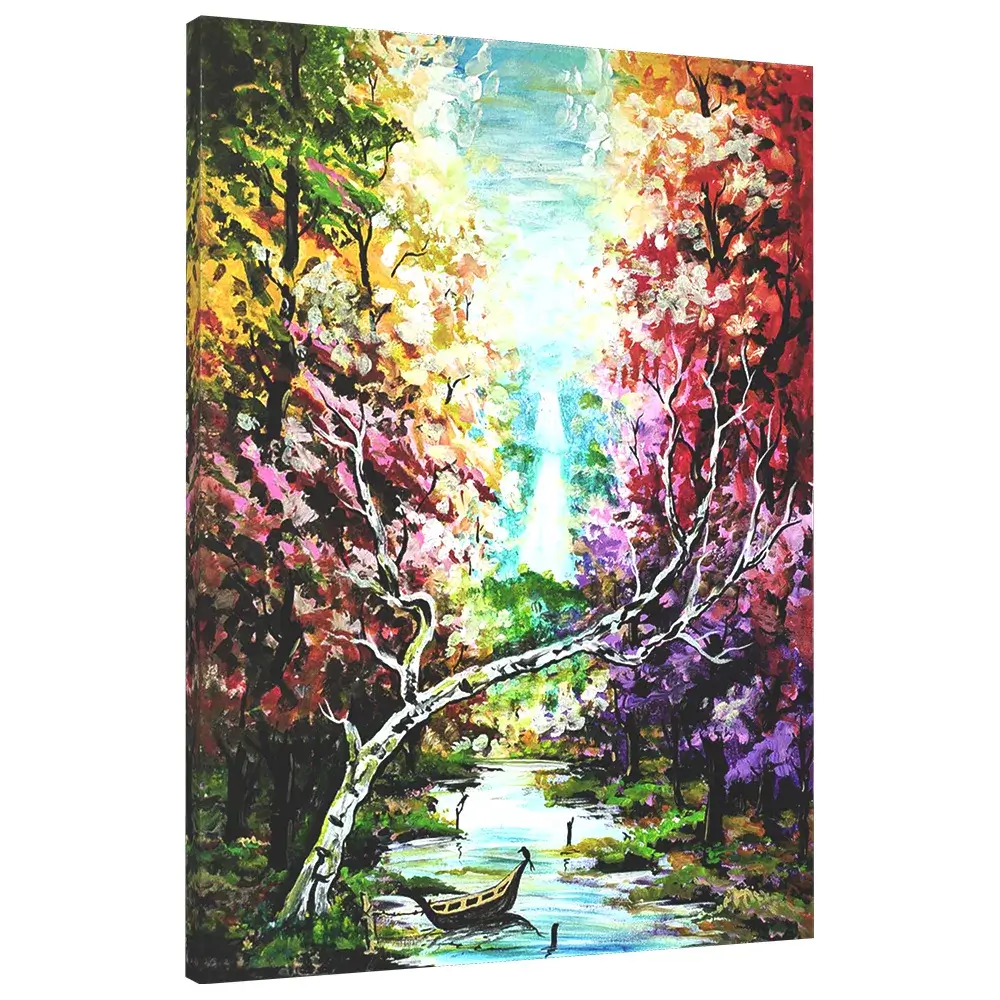
The Four Elements That Do Most of the Work
Water is consistently rated as one of the most calming visual elements across biophilic research, whether it’s a lake, a river, or a distant sea. Greenery and foliage signal safety and abundance in a way that’s deeply wired into how humans read landscapes. Open sky and horizon lines create a sense of space and possibility, which is part of why a room with a landscape painting can feel larger than its actual square footage. And natural light patterns — dawn, dusk, dappled sunlight through trees — tend to feel more restful than flat, midday brightness.
A painting doesn’t need all four to work. But the strongest biophilic pieces usually combine at least two — water and open sky, or greenery and natural light, for example.
Where to Use It in Your Home
Home offices benefit the most, honestly. Studies on biophilic design consistently point to better focus and lower stress in workspaces with natural imagery nearby. A single landscape near your desk does more than people expect. Bedrooms are a close second, especially with softer, dusk or dawn-toned scenes. Living rooms can take something bolder, like a lakeside or open forest view that becomes a conversation piece. Even a small entryway benefits. A calm nature scene as the first thing you see when you walk in sets a very different tone than a bare wall or a mirror ever could.
Pairing Art With Real Greenery
If you already have houseplants, a nature-inspired painting nearby reinforces rather than competes with them. Keep the painting’s tones close to the plant’s foliage. Then the whole corner starts to feel like one intentional, layered scene instead of two separate decorating choices. A cluster of plants beneath a forest-themed painting, for instance, blurs the line between the painted scene and the real one. It reads as deliberate rather than accidental.
It’s also worth thinking about how the painting relates to the rest of the room’s sensory experience — not just its visual one. A nature scene paired with a subtle, natural scent, like cedar or eucalyptus, or with the sound of a small tabletop fountain nearby, reinforces the same calming signal through multiple senses at once. That tends to be more effective than visual cues alone.
A Room-by-Room Example
Picture a small apartment living room with no view beyond a neighboring building. A large forest or lakeside painting on the main wall, paired with two or three houseplants along the windowsill, effectively doubles the room’s connection to nature. And it needs no structural change.
In a home office with a single small window, a landscape positioned directly in your line of sight during video calls does more for how the room feels. That beats any amount of desk organizing. A bathroom is often the most nature-starved room in a house. Even there, a smaller waterfall or river scene brings a surprising amount of calm to a space usually defined by hard tile and fluorescent light.
Biophilic Design Beyond the Painting
Wall art is the easiest entry point, but it works best as part of a slightly broader approach. Natural materials, like wood, stone, linen, and rattan, reinforce the same message a landscape painting is sending.
Airflow and fresh air matter too. A room that looks connected to nature but feels stale and closed up loses some of the effect. And where you can, orient seating to face the painting rather than away from it. That way you actually benefit from it during the time you spend in the room, rather than letting it exist only as background decor you rarely look at directly.
Choosing Between a Forest, a Lake, or a Mountain Scene
Forest scenes tend to feel the most enclosed and intimate. They suit bedrooms and reading nooks, where a cozy, sheltered feeling is welcome. Lake and river scenes feel more open and social, which suits living rooms and dining areas. Mountain views carry a sense of scale and distance that works particularly well in a home office. Design research links that feeling of vastness to a small but real boost in creative thinking. None of these is objectively stronger than the others. The right choice depends entirely on the mood you want the specific room to have.
Common Mistakes to Avoid
The most common misstep is choosing a nature scene purely for its color rather than its mood. A bright, high-contrast jungle scene might look striking in a thumbnail, but it can read as busy and stimulating rather than calming once it’s actually on the wall. The second is placing a biophilic painting somewhere it won’t actually be seen regularly — a formal room used only for guests, say. The whole point of the effect is repeated, everyday exposure. So it belongs somewhere you spend real time — a desk, a reading chair, a spot near the kitchen table.
Caring for a Landscape Canvas
Dust with a soft, dry cloth in one direction rather than circular scrubbing. Keep the painting out of direct, prolonged sunlight, since UV exposure gradually fades pigments. That especially affects greens and blues, the exact colors doing most of the biophilic work. Avoid hanging it near a radiator, vent, or fireplace. Heat and humidity swings there can cause the canvas to warp slightly over time.
Frequently Asked Questions
Does biophilic design really reduce stress, or is that just marketing?
There’s a genuine, well-documented body of research behind it, largely from workplace and healthcare design studies. That said, the effect size varies by study and setting. It’s a real, measurable trend in design research rather than pure marketing. Still, no single painting will transform your stress levels on its own.
Can an abstract painting be biophilic, or does it need to be a realistic landscape?
Realistic landscapes tend to have the strongest effect, since they most directly reference recognizable natural elements. But an abstract piece built around organic, flowing shapes and earthy tones can carry some of the same calming quality.
How many nature paintings does a biophilic room need?
One well-placed piece in a room you actually spend time in matters more than several scattered around a house. Quality of placement beats quantity here.
Is biophilic design only for homes with a lot of natural light?
No — it’s actually most useful in rooms that lack a good view or enough daylight. A painting can substitute for what the room’s actual windows don’t provide.
Does the size of the painting affect the biophilic benefit?
To some extent, yes. A larger piece that fills more of your field of view tends to have a stronger effect than a small one tucked in a corner. That’s simply because you take in more of the scene at a glance. That said, a well-placed smaller painting in a spot you look at often will usually outperform a large one. Placement beats size when you rarely pass the bigger piece.
Should the painting match the season or time of day I spend most time in the room?
It can help. A home office used mostly during the day suits a bright, daylight scene. A bedroom you wind down in, on the other hand, benefits more from dusk or twilight tones that match the mood you’re trying to create before sleep.
The Bottom Line
You don’t need a hydroponic wall or a skylight to bring biophilic design into your home. A well-chosen landscape painting, hung where you’ll actually see it every day, does a surprising amount of that work on its own. And unlike a living wall, it never needs watering.
Browse our full collection of hand-painted landscape and nature paintings, each one created on canvas by our artists in India.