
Original art occupies an unusual place among things people buy for their homes. It’s decor, but it’s also, quietly, an asset. Furniture and appliances predictably depreciate the moment they leave the showroom. A well-chosen original painting works differently. It can hold its value, and sometimes appreciate meaningfully, while still doing its everyday job of making a room feel complete.
This isn’t a promise that every painting is a guaranteed investment. That would be dishonest. But understanding what actually drives an artwork’s value over time helps you buy smarter. That’s true whether you’re thinking about resale potential, or you simply want a piece that ages well in every sense.
Why Original Art Holds Value Differently Than Other Purchases
Most consumer goods, furniture, electronics, appliances, are mass-produced. Supply can always expand to meet demand, and that keeps resale value low. An original painting is inherently singular. Exactly one of it exists, and that scarcity is the foundation of any value it might hold or gain.
This is also the fundamental difference between an original and a print. A print can be produced in unlimited quantities. That caps its long-term value potential in a way an original simply doesn’t share. None of this guarantees appreciation. Plenty of original paintings never significantly increase in value. But only an original carries the scarcity that makes appreciation possible at all.
A Brief History of Art as a Store of Value
Art has functioned as a store of value for centuries. Wealthy patrons commissioned portraits and altarpieces to signal status during the Renaissance. Colonial-era collectors later amassed works that would anchor major museum collections. What has shifted over time isn’t the underlying logic, scarcity plus reputation plus craftsmanship still equals value, but who has access to that logic.
Original art was once almost exclusively the province of aristocracy and the very wealthy. A broader middle-class art market has grown steadily over the past century. Original paintings from working artists are now genuinely accessible to a much wider range of buyers than a few generations ago. That accessibility doesn’t change the fundamentals of value. But far more people today can buy, live with, and benefit from original art than ever before.
What Actually Drives an Artwork’s Value Over Time

An artist’s growing reputation is the single biggest driver. As a painter’s body of work and exhibition history grow, earlier pieces often become more sought after. Technical quality and craftsmanship matter too. A well-executed painting holds up better critically and visually than a technically weaker piece, regardless of subject. That means competent composition, confident brushwork, and sound use of color all matter.
Condition plays a significant role as well. A painting properly cared for retains far more value than one that has visibly deteriorated. That means staying away from direct sunlight, humidity, and physical damage. Provenance matters too, a documented history of who owned a piece and where it came from. Good provenance adds credibility and can meaningfully affect value, particularly for higher-value works.
Buying for Love First, Investment Second
Art dealers and collectors almost universally offer the same core advice: buy what you genuinely love. Treat any investment upside as a welcome bonus, not the primary reason for the purchase. Predicting which specific paintings will meaningfully appreciate is notoriously difficult, even for professionals who study the art market closely. Treating a painting purchase as a guaranteed financial vehicle sets up unrealistic expectations.
What’s far more reliable is this: a painting you genuinely love keeps delivering value in daily enjoyment for as long as you own it. That holds true regardless of what happens to its resale price. Love-first buying is the safer bet either way.
Limited Edition Prints: A Middle Ground
Between a fully open-edition print and a one-of-a-kind original sits a middle category worth understanding: the limited edition print. It comes in a fixed, numbered quantity, and the artist never reprints it. Because supply is capped rather than unlimited, a genuine limited edition can hold modest value. An open-edition poster print cannot make that same claim. It still falls well short of a true original’s scarcity, and therefore its value potential.
If you’re drawn to a specific artist’s work but an original is out of reach, consider a numbered limited edition instead. Look for one signed by the artist, with clear documentation of the edition size. That’s a more defensible middle ground than an unlimited print, if long-term value matters to you at all.
Original vs Print: The Investment Gap
A print, however well produced, is fundamentally a reproduction. Reproductions don’t carry the scarcity that underpins value appreciation the way an original does. This doesn’t make prints a poor choice. They’re an accessible, budget-friendly way to bring good art into a home. But you should buy them for decorative enjoyment, not any expectation of financial return.
An original, by contrast, carries genuine scarcity from the moment it’s finished. That scarcity is the necessary starting condition for future value growth, even though nothing guarantees that growth.
Buying from Working Artists vs Established Names
Paintings from established, widely recognized artists tend to carry higher upfront prices. Their reputation and market already exist, so value retention tends to be more predictable, if modest. Paintings from working, emerging artists cost considerably less upfront. They carry more uncertainty, but also more potential upside if that artist’s reputation and demand grow over time.
Buying from emerging artists works best as a way to support work you genuinely admire, at an accessible price point. Treat any future appreciation as a pleasant possibility, not an expectation.
Traditional and Culturally Rooted Art as a Long-Term Holding

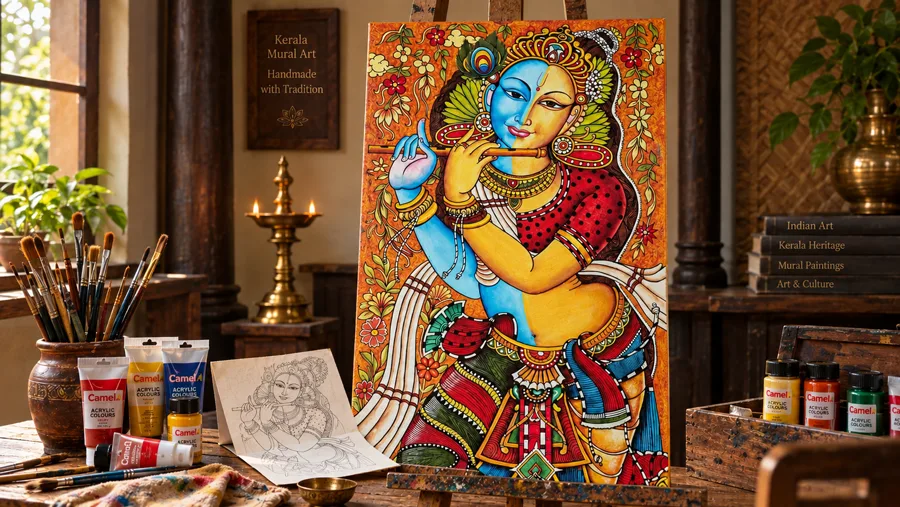
Paintings rooted in a specific cultural or regional tradition carry a different value dynamic than purely contemporary or trend-driven art. Kerala mural painting and Rajasthani miniature-inspired work are two good examples of these heritage-linked styles. These traditions tie to a centuries-old technique and visual language. This work usually holds up against a lasting standard of craftsmanship, not a shifting decorating trend. That makes it less vulnerable to falling out of fashion than trend-driven decor.
Skilled practitioners of these traditional techniques are also becoming fewer in many cases. That adds a layer of scarcity around genuinely well-executed traditional work, beyond the usual one-of-a-kind scarcity every original painting carries. None of this guarantees appreciation any more than any other category of art does. But it’s a reasonable argument either way. Culturally rooted, technically demanding traditional painting tends to be a comparatively stable long-term holding in the broader art market.
Documentation That Protects an Original’s Value
A certificate of authenticity confirms the artist, title, medium, and date. Obtaining one is one of the simplest and most important steps when buying an original. Keep it safely alongside your purchase receipt. High-resolution photographs of the piece, taken at the time of purchase, document its original condition. That matters if you ever need to prove no damage or deterioration happened later.
If you buy a piece through a gallery or directly from an artist with exhibition history, keep a record of that provenance. Even a modest record adds credibility. That can matter considerably if you ever choose to sell.
Protecting an Original’s Condition, and Therefore Its Value
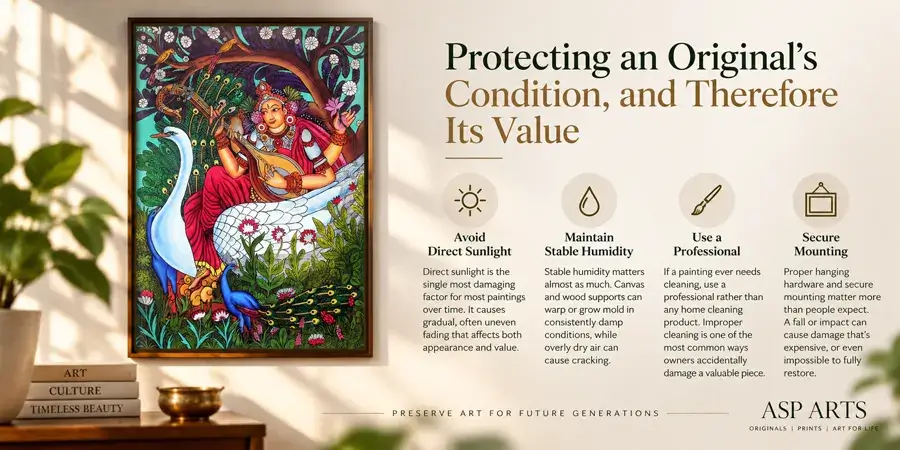
Direct sunlight is the single most damaging factor for most paintings over time. It causes gradual, often uneven fading that affects both appearance and value. Stable humidity matters almost as much. Canvas and wood supports can warp or grow mold in consistently damp conditions, while overly dry air can cause cracking.
If a painting ever needs cleaning, use a professional rather than any home cleaning product. Improper cleaning is one of the most common ways owners accidentally damage a valuable piece. Proper hanging hardware and secure mounting matter more than people expect. A fall or impact can cause damage that’s expensive, or even impossible, to fully restore.
Insuring an Original Painting
For any painting with meaningful value, check whether your existing home insurance covers it adequately. Standard home policies sometimes cap coverage for individual valuable items well below what a painting is actually worth. Consider a separate fine art rider if that’s the case.
Keep your purchase receipt, certificate of authenticity, and any recent appraisal together in one place. That makes a future insurance claim considerably smoother.
When to Consider Selling an Original
Most people who buy original art never intend to sell it, and that’s entirely reasonable. But if you do reach that point, a few signals are worth watching for. A meaningful, sustained rise in an artist’s reputation is one clear signal. Watch for more exhibitions, more critical attention, and more demand for their current work. These often mean earlier pieces from that career have appreciated.
A change in your own space or circumstances, downsizing, a shift in taste, is a perfectly valid reason to sell too. It doesn’t require any particular market signal to justify it. Get an updated appraisal before selling, rather than relying on your original purchase price. Value can move in either direction over the years, and an outdated assumption can cost you at the negotiating table.
Common Mistakes to Avoid
The most common mistake is buying purely for speculative value while disliking the piece itself. That leaves you stuck with art you don’t enjoy if the anticipated appreciation never happens. The second mistake is neglecting basic condition care. Sunlight exposure and humidity damage quietly erode value over the years, in ways that are easy to overlook day to day.
The third mistake is skipping documentation at the time of purchase. A missing certificate of authenticity or provenance record can meaningfully limit resale value, even for a genuinely well-made original.
Building a Small Art Collection Over Time
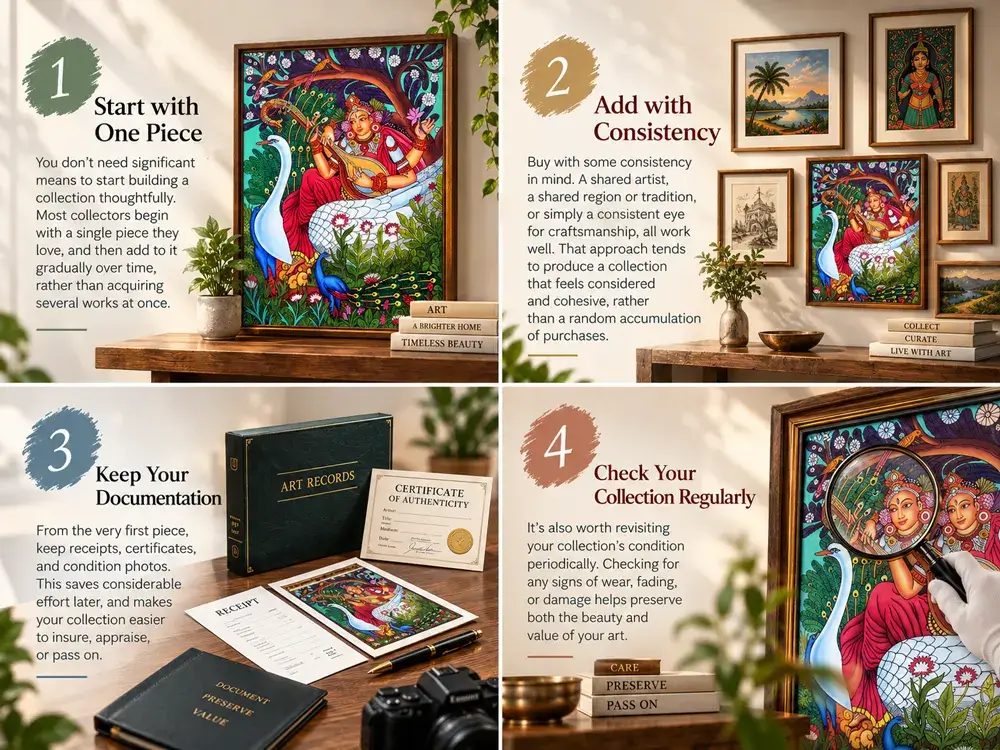
You don’t need significant means to start building a collection thoughtfully. Most collectors start with a single piece they loved, then add to it gradually over years, rather than acquiring several works at once. Buy with some consistency in mind. A shared artist, a shared region or tradition, or simply a consistent eye for craftsmanship, all work well. That approach tends to produce a collection that feels considered and cohesive, rather than a random accumulation of purchases.
Keep organized documentation from the very first piece, receipts, certificates, condition photos. That saves considerable effort later, and makes the whole collection easier to insure, appraise, or pass on. It’s also worth revisiting your collection’s condition periodically. Check that pieces still hang safely, away from sunlight, with no signs of humidity damage, rather than assuming a painting needs no attention once it’s up.
Frequently Asked Questions
Do all original paintings increase in value over time?
No. Value depends on the artist’s reputation, technical quality, condition, and market demand, and no one can guarantee any of them. Many original paintings hold roughly steady value rather than appreciating significantly.
Is buying art from an emerging artist a good investment strategy?
It carries more risk and more potential upside than buying from an established name. Think of it as supporting work you love at an accessible price. Treat any appreciation as a bonus, not an expectation.
What documentation should I keep when buying an original painting?
A certificate of authenticity, the original purchase receipt, and photographs of the piece’s condition at the time of purchase are the essentials.
Should I insure a painting separately from my home policy?
For any piece of meaningful value, it’s worth checking your policy’s per-item coverage limit, since standard home insurance sometimes caps individual item coverage below what a painting is actually worth.
Is a limited edition print worth more than an open edition print?
Generally yes. Its fixed, numbered supply gives it a degree of scarcity an unlimited print doesn’t have. It still falls well short of a one-of-a-kind original’s long-term value potential, though.
How often should I get an original painting appraised?
There’s no strict rule. Checking in every few years is a reasonable approach for a piece of meaningful value. The same goes before any major decision, selling, insuring at a higher value, or including it in an estate plan.
A Note on Realistic Expectations
It’s worth being clear-eyed about what original art can and can’t reliably do financially. It is not a liquid asset. Selling a painting well typically takes time, the right buyer, and often a gallery or auction relationship, unlike a stock you can sell in seconds. Nothing guarantees it will outperform other kinds of savings or investment either.
Treating art primarily as a financial vehicle, rather than something you want on your wall, is generally the wrong frame for most buyers. What original art reliably offers is something different. You get decades of daily enjoyment and a tangible connection to craftsmanship. Often, you also get a meaningful piece to pass down. Those returns don’t show up on a balance sheet. But they matter just as much to most people who choose to collect.
The Takeaway
Original art can genuinely hold and grow in value. But that potential rests on scarcity, craftsmanship, condition, and documentation, not certainty. Buy what you love first, care for it properly, and keep good records. Whatever happens to its market value, you’ll still have a painting worth having on your wall every single day.
Explore our full collection of original paintings, hand-painted on canvas by our artists in ASP Ars, Kerlala, India.