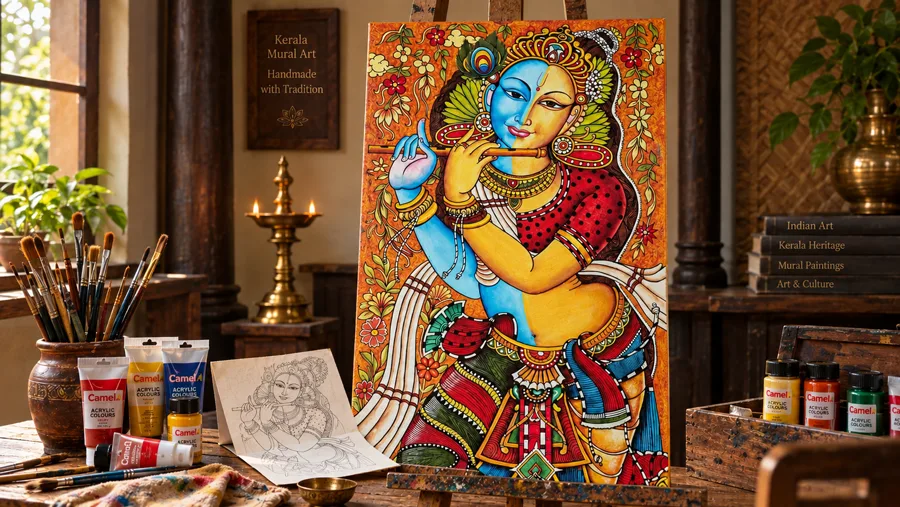
Long before framed canvases and gallery walls, Kerala’s temples and palaces were covered with something remarkable. Dense, richly colored murals painted directly onto walls have dominated the landscape. Artists used natural pigments and created a visual language that hasn’t fundamentally changed in centuries. Today, that same tradition has found a new home, not on temple walls, but on canvas. Modern homes feature these works in living rooms, hallways, and studies far beyond Kerala itself.
If you’ve ever been drawn to a painting with unusually intricate detail, there’s a reason. Bold natural pigments catch the eye. A distinctly Indian visual character stands out. There’s a good chance you were looking at something in the mural tradition. Here’s what makes this style distinctive. And here’s how to bring it into a modern home.
A Brief History of Kerala Mural Art
Kerala mural painting traces back well over a thousand years. Artists developed it primarily on the walls of temples and royal palaces across the region. The style drew from Kerala’s broader artistic traditions. Classical dance forms and sculpture influenced the approach. This resulted in a visual language built on flowing lines, elaborate ornamentation, and highly stylized figures. The figures display distinctive facial features and postures. Traditionally, artisans extracted pigments entirely from natural sources. Mineral and plant-based colors were ground and prepared by hand. This process gave originals an earthy, deeply saturated palette. Later reproductions still try to capture that quality.
What Makes the Style Visually Distinctive
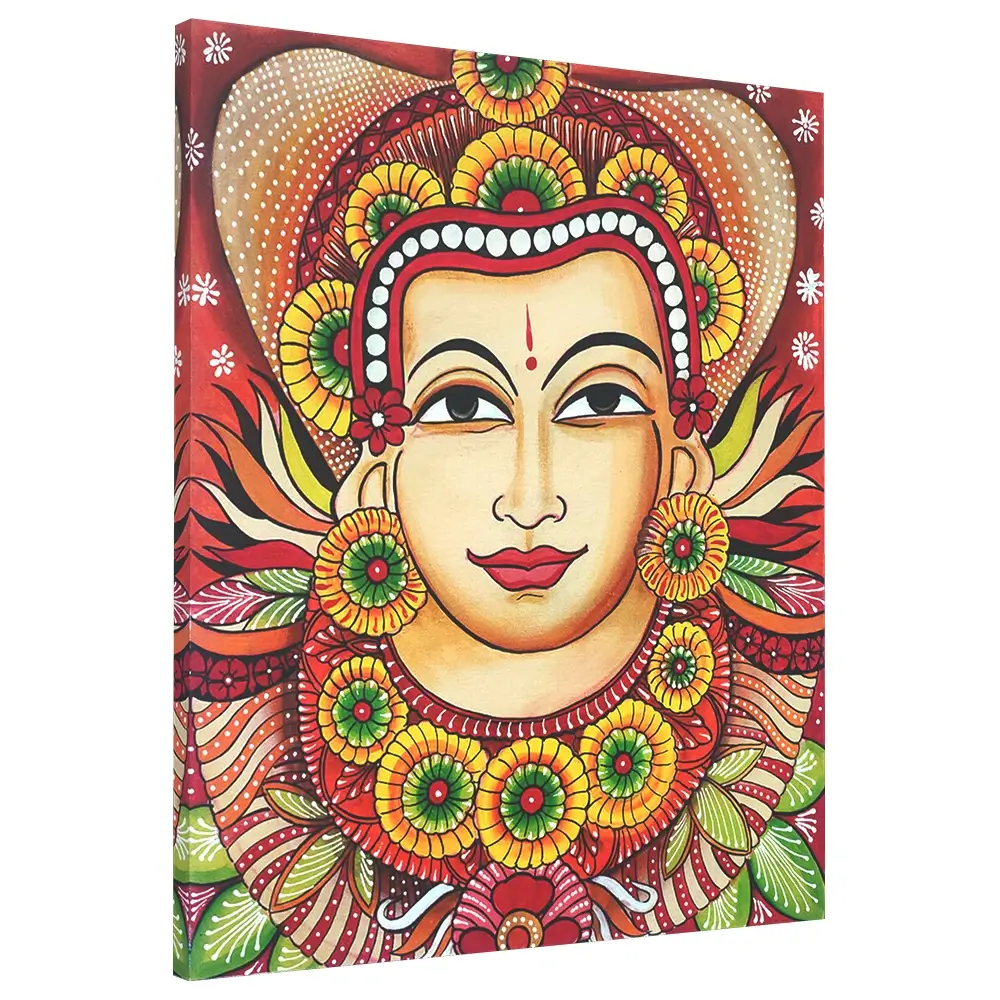
A handful of features set Kerala mural art apart from other Indian painting traditions almost immediately. Figures typically appear in profile or three-quarter view. Artists render elongated eyes with expressive, often theatrical facial expressions. The region’s classical performance traditions inspire this approach. Ornamentation is dense and deliberate. Artisans render elaborate crowns, jewelry, and clothing patterns in fine, careful detail. They don’t leave these elements simple. The color palette leans on deep reds, ochres, greens, and golds. Historically, artists drew these colors from natural pigment sources. Compositions typically pack edge to edge. Very little empty background space remains. This strikes a contrast to the negative-space-heavy minimalism popular in contemporary decor.
Common Subjects in Mural Art
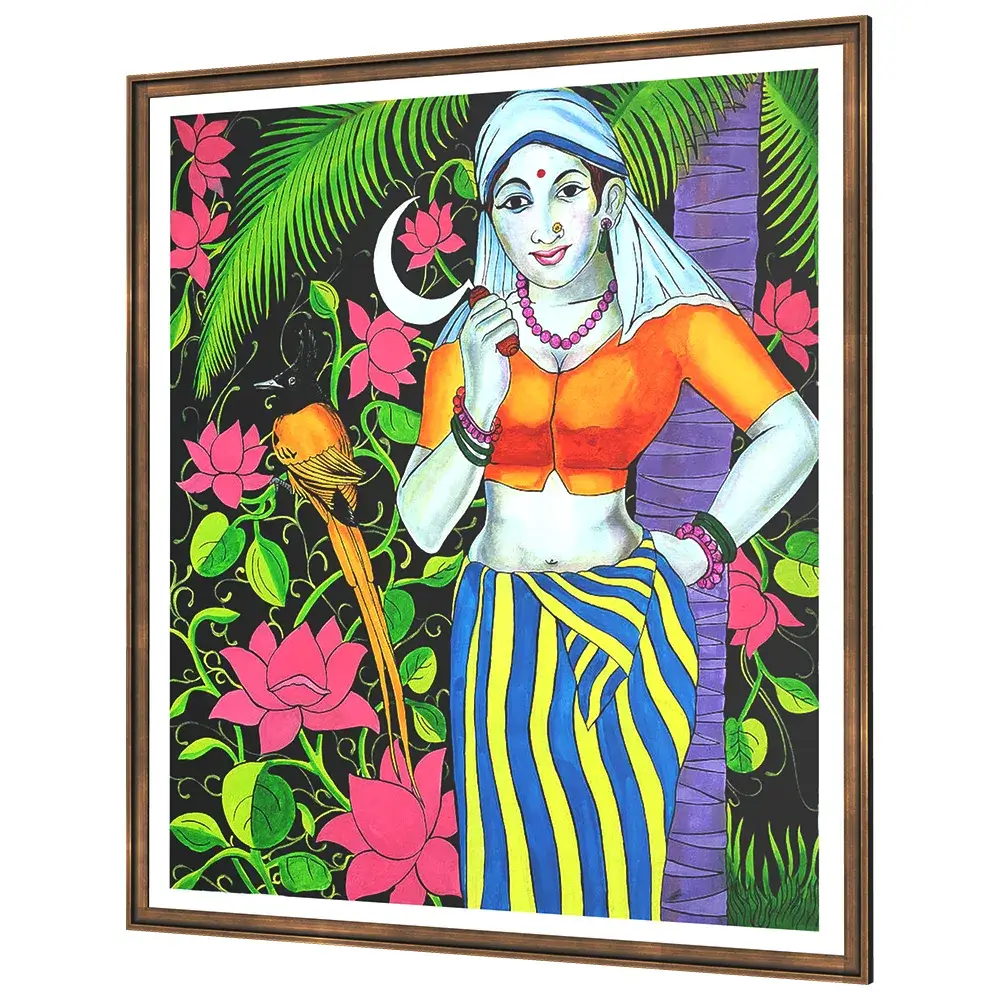
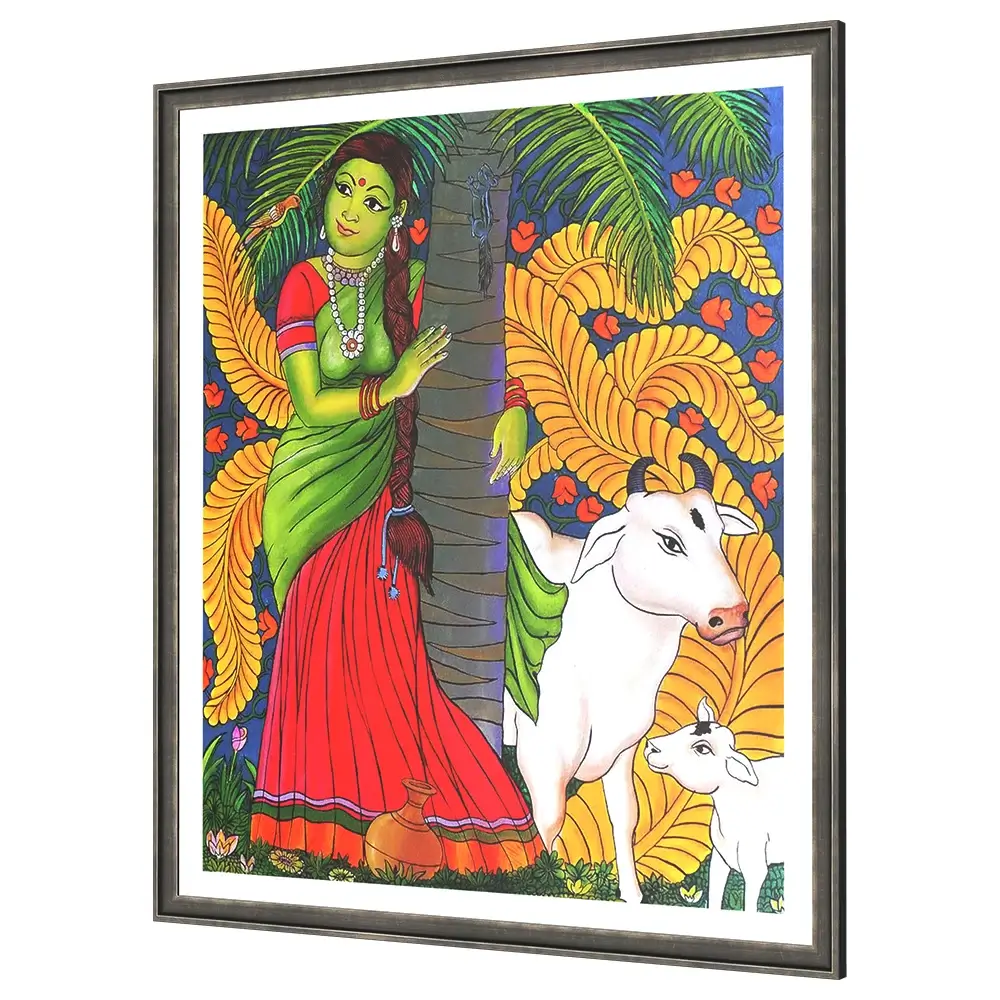
Deities and mythological scenes make up a large share of traditional mural subject matter. Artists render Krishna and Radha, Saraswati, and other figures in the tradition’s distinctive style. However, the style has expanded beyond purely religious subjects. It now includes everyday and cultural scenes. Village life appears in murals. Rural figures populate canvases. Portraits of ordinary people receive the same rich detail and warm palette. These once defined only temple walls. This broader range means mural-style art suits a home decorating project. Even someone not specifically drawn to religious imagery can appreciate it. The style’s visual richness works on its own terms.

Where Mural Art Suits a Modern Home
Given the density and richness of the style, mural art works best as a genuine focal point. Don’t use it as a background piece. Position it on a living room statement wall. Place it in a formal entryway. Feature it in a study meant to reflect a specific cultural or aesthetic interest. The style pairs particularly well with warm, earthy interiors. Natural wood, terracotta, and warm neutrals complement the aesthetic. The palette echoes the mural tradition’s own natural pigment origins. In a very minimalist, cool-toned modern home, a mural piece can still work beautifully. But it will read as a deliberate, bold contrast. It won’t blend quietly into the room. Embrace this contrast rather than fighting against it.
Mural Art in Contemporary vs Traditional Interiors
In a traditional or heritage-style interior, mural art fits naturally alongside other classical Indian design elements. Carved wood furniture, brass accents, and traditional textiles complement it. They extend a cohesive cultural thread through the whole room. In a contemporary or minimalist interior, a single mural piece serves as a deliberate cultural anchor. One richly detailed, meaningful painting stands out. Everything around it is comparatively simple and restrained. Both approaches work well. The key is being intentional. Decide which effect you’re going for. Rather than accidentally landing somewhere in between, make a clear choice.
Sizing and Placement
Because mural compositions are so densely detailed, they generally benefit from a larger canvas size. A simpler abstract or landscape piece might have similar visual impact at a smaller scale. Mural detail needs enough physical scale. Otherwise, fine details get lost. A living room statement wall suits a larger mural piece well. A smaller mural painting can still work in a study or hallway. Viewers must have the chance to look at it up close. A piece glimpsed only from a distance undersells what makes the style special.
Original Hand-Painted Mural Art vs Prints
The mural tradition is fundamentally a hand-craft technique. It’s built on painstaking detail work and natural pigment application. The gap between an original and a print is unusually significant in this particular style. Fine linework is central to what makes mural art distinctive. Subtle color layering contributes to its appeal. The texture of hand-applied pigment matters tremendously. Mechanical reproduction loses a lot of that character. An original hand-painted mural piece preserves the craftsmanship the tradition is actually built on.
Framing Mural Paintings
Simple, understated frames actually work best with mural art. This is true despite the busy, ornate quality of the paintings themselves. An equally ornate frame competes with the composition. It won’t support the artwork. A plain wood or dark frame is better. It gives the eye a clean boundary. Viewers dive into the painting’s own dense detail. This reads as more intentional. Pairing intricate art with an equally intricate frame creates competition, not harmony.
How a Mural Painting Is Traditionally Made
Traditional Kerala mural work follows a fairly involved process. This is true even when adapted to canvas rather than a temple wall. Artists first sketch out the composition in careful outline. The dense, edge-to-edge detail leaves little room for improvisation later. Color then builds up in layers. Artists typically start with deeper background tones. They work forward toward finer foreground detail. Jewelry, facial features, and decorative borders come next. Outlining, often in a fine, dark line, is usually one of the final steps. This sharpens every shape. It gives the whole composition its characteristic crispness. This happens despite the density of detail. This layered, disciplined process requires considerable time. A genuine mural-style painting takes considerably longer to complete. A looser, more spontaneous painting style finishes much faster.
Mural Art Within the Wider Family of Indian Painting Traditions
India has an unusually rich range of regional painting traditions. Understanding where Kerala mural art sits among them is helpful. Madhubani painting, from Bihar, is known for its bold geometric patterns. Folk-art simplicity defines this style. Warli painting, from Maharashtra, uses minimal, almost stick-figure style forms. White paint on an earthy background characterizes this technique. Tanjore painting, from Tamil Nadu, leans on gold leaf and relief work. A more opulent, jewel-like finish results from this approach. Kerala mural art distinguishes itself through a specific combination. It features naturalistic figure proportion. Elaborate ornamentation sets it apart. A specific palette rooted in temple-wall pigments defines its character. It’s more detailed and figure-focused than Warli. It’s less overtly gilded than Tanjore.
Mural Art as a Meaningful Gift
For anyone with a connection to Kerala or South Indian culture, a mural-style painting makes a particularly resonant gift. It carries genuine cultural and artistic weight which can go beyond simple decoration. A Mural painting suits housewarming gifts for someone setting up a home with Indian heritage decor in mind. It works especially well as a gift for someone living outside India. They want a tangible, meaningful piece of that cultural connection on their wall.
Living With Mural Art Day to Day
Because of the sheer amount of detail in a genuine mural painting, many owners discover something new in the composition even after months or years. Viewing such a piece reveals new details constantly—perhaps a small decorative flourish catching the eye. You might notice subtle color transitions emerging. Often, an expression that hadn’t fully registered before suddenly becomes apparent. This creates a genuinely different kind of relationship with a painting. A simpler abstract or landscape piece gives an instant, complete impression. Mural art rewards deeper engagement. It’s one of the specific rewards of choosing a piece this detailed. Choose it for a space you’ll spend real time in.
Common Mistakes to Avoid
The most frequent mistake is under-sizing a mural piece. Choose something too small and fine detail won’t register properly. This undersells exactly what makes the style special. The second is pairing it with an equally ornate, heavily decorated frame. The frame fights the painting. It doesn’t frame it. The third is placing it somewhere it won’t get close, sustained attention. A mural painting rewards a slower look. It rewards sustained viewing far more than a piece glimpsed only in passing.
Caring for a Mural-Style Canvas
Dust gently and regularly with a soft, dry cloth. Take extra care around raised or textured detail work. Dust settles more heavily there than on a flat surface. Keep the piece out of direct, prolonged sunlight. Traditional earthy pigment tones can fade with extended UV exposure. Avoid humid environments where possible. Never use household cleaning products directly on the painted surface.
Classical Mythological Subjects in the Mural Tradition
Alongside everyday and cultural scenes, classical mythological subjects built the mural tradition. They remain among its most popular and widely collected today. Krishna and Radha, rendered together in the mural style’s characteristic flowing, ornamented linework, is one of the most enduring compositions. The entire tradition features this pairing. It appears across temple walls throughout Kerala. Generations have painted it. These pieces work particularly well in a home study. A meditation corner suits them well. They function excellently in a formal living room. Their scale and detail need proper appreciation. Viewers should look at them at a comfortable, unhurried distance.

Building a Room Around a Mural Piece
Because mural paintings carry so much visual weight on their own, the surrounding room generally benefits from restraint elsewhere. Use simple furniture silhouettes. Include a limited number of additional decorative objects. Choose warm but understated wall colors. These choices let the mural piece remain the clear focal point. The painting won’t compete with an equally busy room. A single well-placed mural painting, given this kind of supporting space, tends to have far more presence. The same piece crowded into a room full of other patterned or highly decorated elements loses impact.
Pairing Mural Art With Other Decor Styles
Mural art doesn’t require an entirely traditional room to work well. Pair it with mid-century or contemporary furniture successfully. A single mural piece becomes a striking point of cultural contrast. The whole room doesn’t need to match the painting. Natural materials bridge the gap most gracefully. Rattan, teak, and brass complement both traditional and modern aesthetics. They give the room a sense of continuity. Individual pieces span very different design eras. Fully modern, glossy, high-shine interiors present challenges. The mural’s earthy, matte natural-pigment quality can feel visually at odds with very polished, reflective surfaces nearby.
Lighting a Mural Painting Properly
Given how much fine detail a mural composition holds, good lighting genuinely changes the viewing experience. A dedicated picture light reveals much more. Angle it to minimize glare while illuminating the full canvas evenly. Flat, indirect ambient lighting tends to leave detail in shadow. This is particularly true in the deeper, more richly colored areas of the composition. Warm-toned lighting suits the traditional earthy palette better. Cool white light can make the natural pigment tones look slightly washed out. It may even appear clinical by comparison.
Frequently Asked Questions
Is Kerala mural art only suitable for religious or deity subjects?
No. While deities and mythological scenes are a major part of the tradition, the same technique applies to everyday and cultural subjects too. Rural life, portraits, and scenes without any religious content all use this approach.
Does mural art suit a modern, minimalist home?
Yes, though it works differently there than in a traditional interior. In a minimalist space, a single mural piece becomes a deliberate, bold cultural statement. It doesn’t blend into an overall traditional aesthetic.
What’s the difference between Kerala mural art and Tanjore painting?
They’re distinct regional traditions. Tanjore painting, from Tamil Nadu, is known for its use of gold leaf and gemstone embellishment. Kerala mural art is defined by its natural pigment palette, elongated figure style, and dense, edge-to-edge composition.
What size works best for a mural-style painting?
Larger sizes generally suit the style best. Fine detail needs enough canvas space to be properly appreciated. This is particularly true for a statement piece meant to anchor a room.
How long does an original mural-style painting take to create?
Given the layered process (outline, base color, detail work, final outlining), a genuine mural piece typically takes considerably longer than a looser painting style. Expect several weeks depending on the size and level of detail involved.
Can Kerala mural art be commissioned in a custom size?
Many studios, including ours, can accommodate custom sizing for mural-style commissions. Discuss timelines directly given the detailed, time-intensive nature of the technique.
The Takeaway
Kerala mural art brings a genuine sense of history and craft into a home. Most contemporary styles simply can’t offer this. It’s a visual tradition built over centuries. Artisans still practice it by hand today. Given the right scale, placement, and a simple frame, it becomes one of the most distinctive pieces. A room can hold few things more conversation-worthy.
Explore our full Kerala mural painting collection, hand-painted on canvas by our artists in India.